How to teach teachers to use AI: Where to start with your staff
Help your staff build AI literacy with differentiated training, ongoing support, and tools that save time.
Tori Fitka • Jan 22, 2026 • Updated Jun 17, 2026
Instructional Coaching & Professional Learning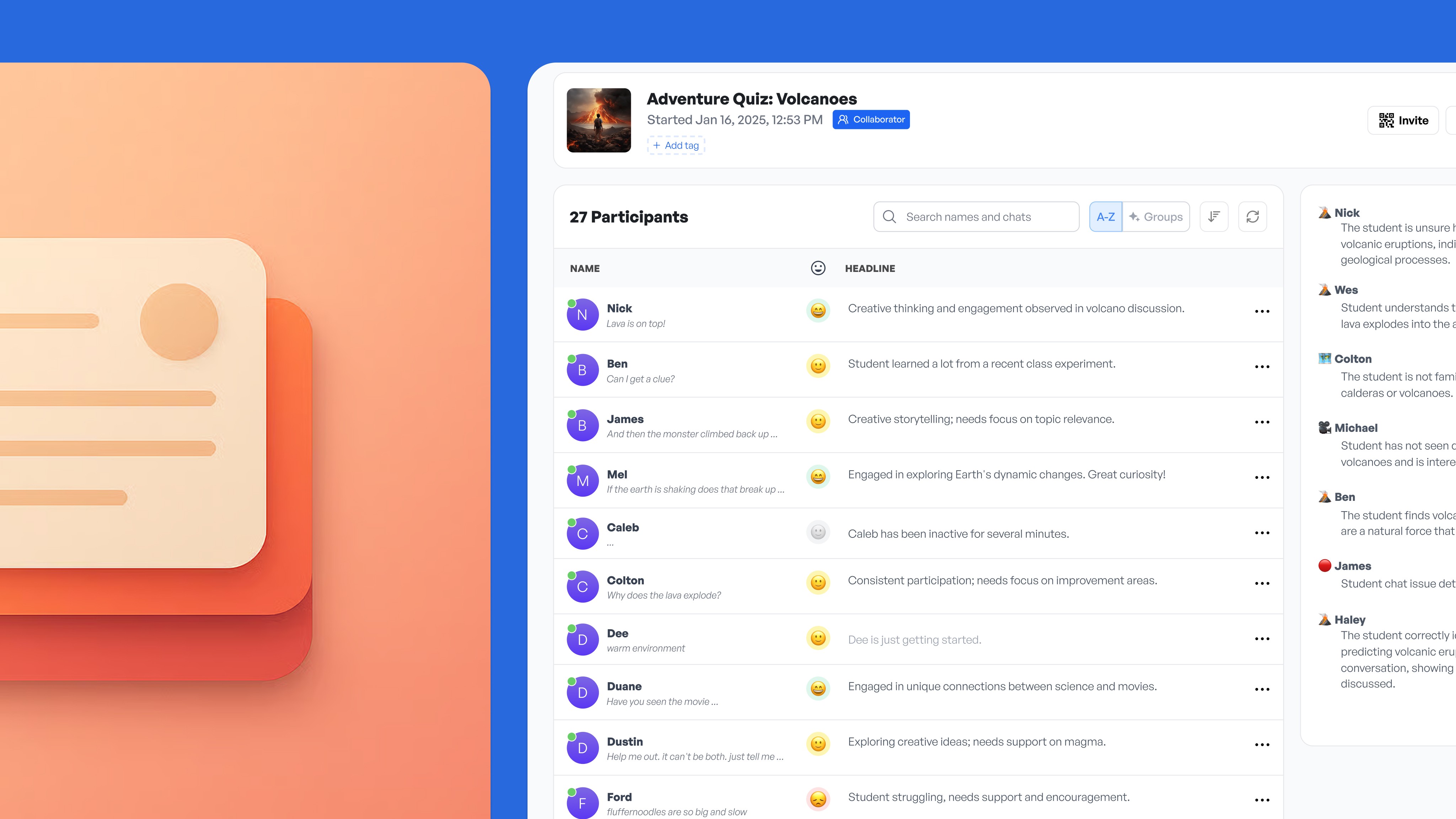
Key takeaways
-
Most teachers worry about AI's impact on student relationships more than technical complexity, so address these concerns before diving into tools.
-
Start with differentiated entry points based on teacher readiness rather than requiring everyone to adopt AI at the same pace.
-
One-time training sessions aren't enough. Sustainable AI adoption requires layered, ongoing support, including coaching, check-ins, and protected time to experiment.
-
High-poverty districts lag significantly behind in AI training access, requiring intentional equity-focused planning from the start.
-
Addressing data privacy and AI limitations early builds teacher confidence and helps avoid common pitfalls during implementation.
Building teacher AI literacy matters for your staff, and district leaders across the country are moving fast. 60% of districts had already implemented training by 2024, and adoption continues to accelerate as more districts recognize AI literacy as essential for preparing teachers and students for the future.
But knowing you need to start and actually knowing where to start are two different things. The good news? Research from the past two years shows what actually works. But success requires clear planning and sustained commitment.
You need to provide structured professional development and job-embedded coaching support. And you need to build systemic conditions that make AI feel less like another initiative and more like a tool that genuinely gives time back.
Start by talking about relationships, not technology
Want to know where to start with building teacher AI literacy? Don't begin with technical explanations of how large language models work. Start with what teachers actually worry about: how AI affects their students and what it means for their relationships with kids.
For many teachers, the biggest barrier to adopting AI is worrying about what it means for their students. Concerns about AI's role in society and its impact on student-teacher relationships consistently outrank technical challenges as the top reason educators hesitate. That's a significant portion of your staff worried about whether using AI means giving up what matters most about teaching: the human connection with kids.
District leaders get this. When researchers surveyed school districts, nearly all leaders said their primary focus for AI training was addressing teachers' concerns, confusion, and fears about the technology, not teaching them which buttons to click.
What does this look like in practice? Before you introduce any AI tools, create space for honest conversation. Host listening sessions where teachers can voice their fears.
These are the questions teachers need to explore together:
-
Will AI replace the human connection with my students?
-
How do I maintain academic integrity when students can generate essays instantly?
-
What if not all students have equal access at home?
-
Does using AI mean I'm not really teaching anymore?
These concerns deserve more than a quick reassurance in a staff meeting. When teachers feel heard on these relationship-centered worries first, they're significantly more open to exploring AI's practical applications later.
Meet teachers where they actually are
Consider Maria, a 15-year veteran English teacher. When her district announced mandatory AI training, she panicked. Not because she couldn't learn the technology, but because she'd spent years perfecting her writing conference approach. She worried AI would replace those crucial one-on-one moments where she helps students find their voice.
Her district's training started differently than she expected. Instead of diving into AI tools, the facilitator asked: "What takes time away from your students?" Maria listed grading mechanics in rough drafts, writing parent emails, and creating differentiated reading materials. Only then did the trainer show how AI could handle those tasks, giving Maria more time for the teaching she loved.
This is differentiated professional development in action. Just as you wouldn't teach all students the same way, you can't train all teachers identically. Research shows successful districts create multiple entry points:
-
For skeptical teachers: Start with time-saving administrative tasks like drafting parent communications or generating quiz questions. Let them experience the benefit before asking them to change their instruction.
-
For curious but cautious teachers: Provide structured exploration time with clear guardrails. Give them pre-built lesson templates they can customize rather than starting from scratch.
-
For ready-to-innovate teachers: Turn them into your pilot group. Let them test tools, share what works, and become peer coaches for colleagues.
The key is making AI adoption feel voluntary even when it's not. When teachers choose their starting point based on readiness, adoption rates jump dramatically.
Teach the basics before the tools
Understanding how to teach teachers to use AI means recognizing that foundational knowledge matters as much as hands-on practice. Before teachers can use AI effectively or guide students in using it responsibly, they need a working understanding of what AI actually is, and what it isn’t. You don't need to turn every educator into a computer scientist, but grounding staff in a few core concepts early prevents confusion and builds confidence throughout the rest of your training.
Cover these foundational areas in your early professional development sessions:
-
What generative AI is and how it produces outputs (including why it can be wrong)
-
The difference between AI as a tool and AI as a replacement for professional judgment
-
How AI models are trained and why bias can appear in outputs
-
Why AI "hallucinations" happen and how teachers should fact-check before using any AI-generated content with students
-
Basic prompt structure, how the way you ask a question shapes the answer you get
Build prompt skills into your training
One of the most practical skills you can give teachers is knowing how to communicate effectively with AI tools. Many educators try AI once, get a generic or unhelpful response, and conclude the tool isn't useful, when the real issue is prompt design. Teaching teachers how to craft better prompts is one of the highest-leverage investments a district can make in AI professional development.
A simple framework for structuring prompts helps teachers get useful results faster:
-
Set the context: Tell the AI who it's talking to and what you need. ("I'm a 4th-grade math teacher preparing a lesson on fractions for students who are struggling with the concept.")
-
State the task clearly: Be specific about the output you want. ("Write three real-world word problems at a 3rd-grade reading level.")
-
Add constraints: Specify format, length, or tone. ("Use bullet points. Keep each problem to two sentences.")
-
Refine the output: Show teachers that prompting is a conversation; they can ask the AI to adjust, clarify, or redo any part of the response.
Peer-led workshops where teachers share prompt examples that worked in their specific subject areas accelerate this learning faster than any top-down training approach.
Build support systems that actually sustain change
Here's the hard truth: one-time training sessions don't work. Teachers attend, feel inspired, then return to their classrooms where the daily chaos makes trying something new feel impossible.
Schools seeing real results build three levels of support:
1. Just-in-time help when teachers get stuck
Designate tech-savvy teachers as AI coaches who can answer questions during planning periods. Create a shared space where teachers post problems and solutions.
2. Regular check-ins to troubleshoot and celebrate
Schedule monthly 30-minute sessions where teachers share what's working. When Jessica shows how she used AI to create reading passages at five different levels, three other teachers try it that week.
3. Protected time to experiment without pressure
Give teachers one period per month to explore AI tools with no expectation of immediate classroom implementation. Experimentation needs space to breathe.
School AI's Mission Control is particularly powerful for ongoing support. It surfaces which students need assistance across all your classrooms, complete with conversation transcripts showing exactly how they got stuck. Your instructional coaches can use these insights to identify patterns: Are multiple teachers struggling with the same implementation challenge? Are certain types of AI interactions consistently successful?
Address data privacy and AI limitations early
A training program that skips data privacy is an incomplete one. Before teachers bring any AI tool into their workflow, they need clear, explicit guidance on what information should never go into an AI system and why. Free or consumer-grade AI tools are not designed for school environments, and inputting student names, grades, behavioral records, or other personally identifiable information creates real legal and ethical exposure. Establishing these boundaries early doesn't slow adoption; it makes teachers feel safer experimenting, because they know the guardrails. Cover these points in your first or second professional development session:
-
Never input student names, IDs, grades, or behavioral data into non-approved AI tools
-
Understand the difference between district-approved tools with educational data agreements and general consumer AI platforms
-
AI outputs are not always accurate; teachers carry full responsibility for any content shared with students
-
Bias can appear in AI-generated material; review outputs with a critical eye before classroom use
-
Establish campus-level norms for when and how AI is permitted (e.g., brainstorming vs. final assessment)
Address the equity gap now, not later
Research reveals an uncomfortable reality: High-poverty districts lag 1-2 years behind well-resourced districts in providing AI training. By the 2025-2026 school year, nearly all low-poverty districts will have trained teachers, while only 60% of high-poverty districts will have done so – a 40-percentage-point gap.
This isn't just about teacher professional development. It's about which students get teachers equipped to prepare them for an AI-integrated world and which students don't. The pattern is devastatingly familiar: Technology innovations widen existing inequities unless we intervene intentionally.
If you're leading a well-resourced district, consider how you can share what you're learning. Regional partnerships, open-source resources, and collaborative professional development reduce the burden on individual districts to build everything from scratch.
Start Monday with these steps
You don't need a perfect plan to begin building teacher AI literacy. Start where your teachers are and build from there.
-
This week: Host a 30-minute listening session. Ask teachers to share one fear and one hope about AI in education. Just listen. Don't solve or explain yet.
-
Next week: Identify 3-5 teachers at different readiness levels who'd be willing to pilot one AI tool for one specific task. Give them support and ask them to share results in two weeks.
The goal isn't to make every teacher an AI expert. The goal is to help teachers see AI as a tool that gives them more time for what they do best: teaching kids.
Building AI literacy is a journey, not a one-time event
Learning how to teach teachers to use AI is less about finding the perfect tool and more about building a culture where experimentation is safe, supported, and connected to real instructional goals. The districts seeing the strongest results aren't necessarily the ones with the biggest budgets or the most advanced platforms; they're the ones that started with honest conversations, gave teachers differentiated paths forward, and built in the ongoing support structures that sustain change beyond the first training session.
That foundation, relationships first, skills second, systems third, is what separates districts where AI becomes a lasting part of how teachers work from districts where it fades after a few months. When teachers understand the basics, can write an effective prompt, know the ethical boundaries, and have somewhere to turn when they get stuck, AI stops feeling like a disruption and starts feeling like what it actually can be: a tool that makes teaching more sustainable.
SchoolAI is built for exactly that environment. It provides safe, classroom-ready AI where students learn within teacher-designed, guardrailed experiences, and educators get real-time mastery data showing whether students are actually achieving the outcomes that matter. When your staff is ready to explore what AI-supported learning can look like in practice, SchoolAI provides the visibility and infrastructure to do it responsibly, at scale. Sign up for SchoolAI today or request a demo to see how real-time insights help you support teachers exactly when and where they need it.
Frequently Asked Questions
Building teacher AI literacy means helping educators understand how artificial intelligence works, how it is used in instructional tools, and how to evaluate AI outputs responsibly. It includes foundational knowledge about data, algorithms, and model limitations, as well as practical skills for integrating AI tools into teaching in ways that support learning goals and maintain student safety.
AI literacy is important for teachers because AI tools increasingly shape lesson planning, assessment, student support, and administrative workflows. When teachers understand how AI systems function, they can better identify potential bias, validate recommendations, and choose tools that align with instructional needs. Strong AI literacy also empowers educators to guide students in using AI responsibly and to model critical thinking about emerging technologies.
Schools can support teachers in building AI literacy by offering professional development that explains key AI concepts in accessible terms, providing hands-on practice with approved tools, and giving clear guidance on ethical use and data privacy. Effective approaches include workshops, peer-led training, curated resource hubs, and opportunities to experiment with AI tools in low-stakes contexts. Ongoing support and time for teachers to explore new technologies help build confidence and competence over time.

About the author
Tori Fitka
Education Specialist at SchoolAI, Former Digital Learning Coach
Tori spent years as a digital learning coach before joining SchoolAI, helping teachers build confidence with new tools through hands-on practice rather than theory. She now works directly with schools to support AI adoption, designing professional learning that starts where teachers are and gives them something they can use the next day.
Transform your teaching with AI-powered tools for personalized learning
See how every student is doing, and know what to do next.