How standards-based grading supports growth and proficiency
Read how standards-based grading transforms student learning by tracking real progress, not averages. Get practical SBG tips for your classroom.
Jennifer Grimes • Dec 10, 2025
Assessment & Learning Evidence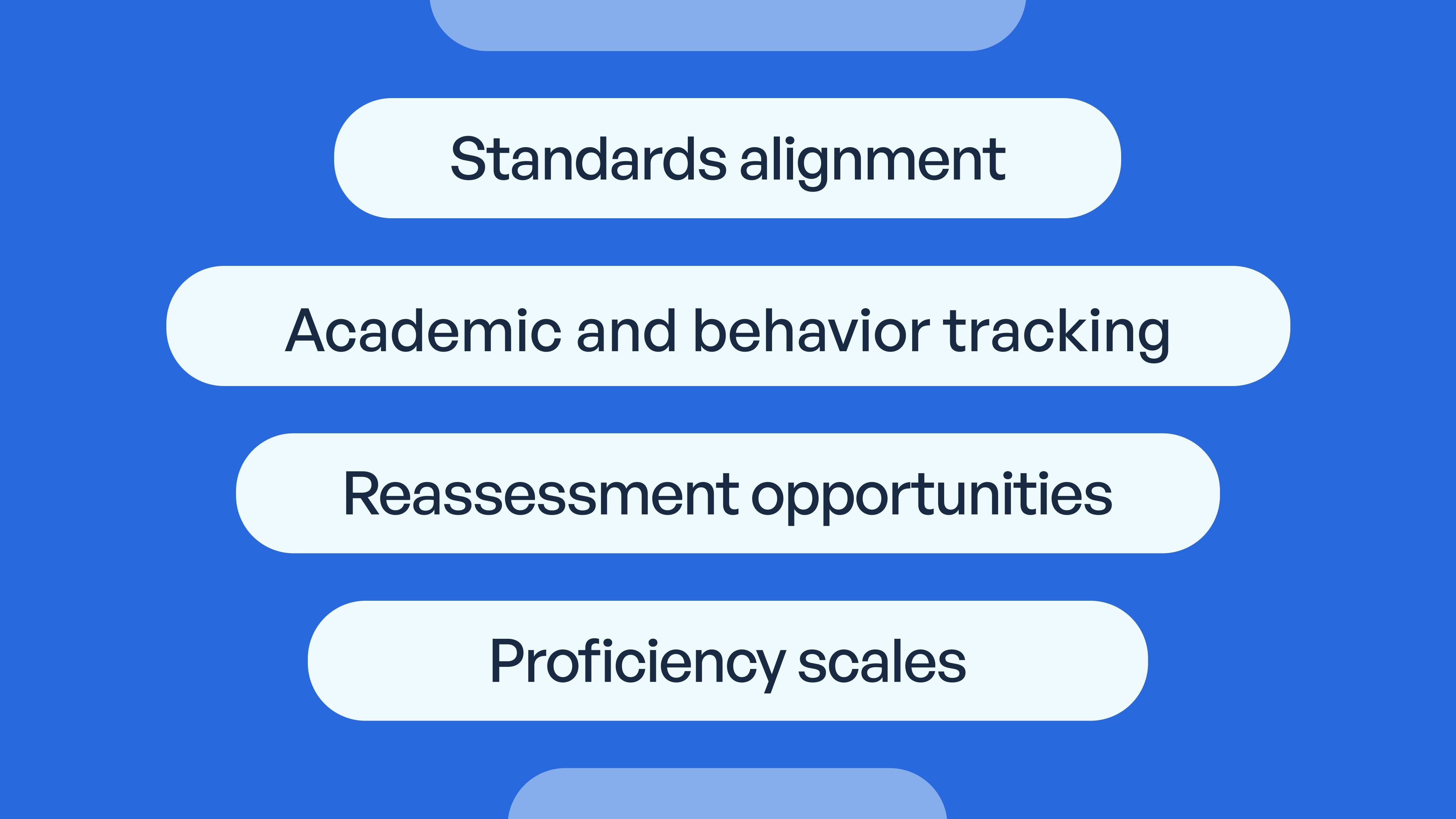
Key takeaways
-
Standards-based grading clarifies learning goals to support student growth and proficiency rather than averaging scores
-
Effective SBG implementation hinges on separating academic proficiency from behaviors and allowing reassessments
-
Reassessment opportunities transform mistakes into learning moments, supporting the growth mindset crucial for deep learning
-
Clear learning targets help students take ownership of their progress and identify exactly what they need to work on next
What if you had a seventh-grader who struggled with fractions at the start of the quarter but kept practicing until he could teach mixed numbers to his classmates? In traditional point-based systems, those early zeros average into a C, even though you and he both know he's mastered the skill. His report card hides his learning journey.
In a traditional grading conference, you might tell parents he has a C in math and needs to turn in homework more consistently and study harder for tests. But with standards-based grading, that same conversation becomes much more helpful: he has mastered fraction operations and decimal conversions. However, he's still developing his understanding of mixed number applications, so we're focusing our practice there.
Which conversation actually helps parents support their child's learning?
The four ingredients of effective standards-based grading
Standards-based grading rests on four essential elements:
-
Standards alignment
-
Proficiency scales
-
Reassessment opportunities
-
Separate academic and behavior tracking
Standards alignment drives every assessment. When it's implemented effectively, instead of "Unit 5 Test: 73%," your gradebook displays specific learning targets, such as "Solve linear equations in one variable." Every assignment is connected to clear standards that students can understand and track. Proficiency scales replace percentages with a consistent 1-4 scale that shows precisely where each student stands on every learning target.
Reassessment becomes standard practice when SBG is implemented correctly. Students can demonstrate new learning on any standard after additional practice, transforming early mistakes into stepping stones for growth.
Academic and behavior tracking are entirely separate, with work habits and citizenship appearing in distinct sections, ensuring grades reflect what students know rather than how well they navigate classroom expectations.
Here's how proficiency scales work across different grade levels, showing the progression from beginning understanding to advanced application:
Grade Level
Level 1
Level 2
Level 3
Level 4
Elementary
Identifies the main idea with support
Identifies with prompts
Independently identifies
Explains and connects to themes
Middle School
Solves equations with errors
Solves with scaffolds
Accurately solves
Applies to real-world problems
High School
Cites evidence vaguely
Cites adequately
Analyzes evidence
Synthesizes multiple sources
Turn mistakes into learning tools, not point deductions
Students in standards-based classrooms develop fundamentally different relationships with learning, mistakes, and academic challenge.
-
**Mistakes become information instead of failures: **When a 10th-grader sees "Approaching Proficient" on argumentative writing, the student knows exactly what to practice. Compare this to receiving a C+ on an essay, which says nothing about thesis development, evidence analysis, or conclusion strength. Research from the Journal of Educational Psychology shows students in mastery-based systems demonstrate 23% higher persistence on challenging tasks.
-
**Students take ownership of their progress: **Clear learning targets give students control over their academic journey. When they can see "Proficient" on solving equations but "Developing" on graphing functions, they direct their study time appropriately, building metacognitive skills crucial for lifelong learning.
-
Growth becomes visible and celebrated: Traditional averaging hides learning progress, but standards-based tracking makes every improvement clear.
The equity implications are significant. Students who need more time to master concepts can demonstrate their knowledge without being penalized for their learning pace or circumstances beyond their control.
Is your grading system hiding what students actually know?
Standards-based grading removes systemic barriers that traditionally penalize students based on factors beyond their academic ability.
-
When grades focus solely on content proficiency rather than speed or homework completion, students with ADHD, dyslexia, or processing differences can demonstrate their knowledge through multiple pathways. This aligns with MTSS frameworks and UDL principles by providing various means of demonstrating understanding.
-
Traditional systems often penalize students who can't complete homework due to work responsibilities, lack of internet access, or chaotic home environments. By separating academic achievement from work habits, standards-based grading ensures grades reflect learning, not life circumstances.
-
For multilingual learners, this separation becomes especially powerful. Students can demonstrate sophisticated mathematical reasoning, scientific thinking, or historical analysis while still developing academic English vocabulary and writing conventions. Rather than having language barriers artificially lower grades across all subjects, these students receive accurate feedback on both their content knowledge and language development, recognizing them as distinct yet equally important areas of growth.
Why SBG students are more ready for college than their peers
Parents and administrators often worry about college acceptance with standards-based transcripts, but research reveals that SBG students demonstrate stronger college readiness skills than their traditionally-graded peers. The mastery-focused approach develops exactly what colleges value most: persistence, self-assessment, and deep learning.
Traditional grading teaches students to accumulate points and move on, even if they haven't mastered foundational concepts. In contrast, standards-based grading of college readiness is based on requiring genuine progress and understanding before advancement. Students develop grit and resilience because they cannot simply accept a C+ and move forward.
The self-assessment skills SBG develops prove crucial for college success. Students enter higher education knowing how to identify knowledge gaps, seek appropriate resources, and persist through challenging material until proficient. While traditionally graded peers struggle with college's expectations, SBG graduates thrive in environments that reward genuine learning over point accumulation.
How to make standards-based grading doable with SchoolAI
The biggest challenge with standards-based grading isn't understanding why it works but managing the workload without burning out. SchoolAI handles the administrative complexity while keeping you in control of instructional decisions.
-
Mission Control provides real-time insights into student learning patterns and identifies those who need support through individual chat transcripts and engagement data.
-
Spaces create personalized learning paths that automatically adjust based on student responses, ensuring appropriate challenge levels while you focus on targeted instruction.
-
Dot acts as an AI teaching assistant providing scaffolded support as students work through standards-based content, allowing you to reach every learner during independent work.
-
PowerUps make standards-based practice engaging through interactive tools like flashcards and presentations that feel less like worksheets and more like exploration.
-
Discover gives you access to over 120,000 educator-created resources for implementing standards-based approaches, including rubrics and parent communication templates, all tested by real teachers.
Your expertise drives every assessment choice while technology manages the organizational complexity that used to overwhelm your evenings.
Simple standards-based grading examples you can try next week
The best way to understand how standards-based grading supports student growth is to see it in action. These simple implementations show how SBG transforms learning across grade levels, with SchoolAI tools making the transition manageable for busy teachers. Here's a sample rollout plan.
Week-by-week SBG implementations with SchoolAI support
Grade level
Week 1 try this
Learning target
SchoolAI tool support
Growth indicator
Elementary (3-5)
Replace spelling test grades with proficiency tracking
"Spell words with silent letters"
Mission Control tracks individual student progress on spelling standards in real-time
Students retake until competent, celebrate visible progress
Middle school (6-8)
Track one math standard instead of unit averages
"Solve multi-step equations"
Spaces provide personalized equation practice with Dot coaching each student to proficiency
Students focus practice on specific skill gaps
High school (9-12)
Separate essay content from grammar/mechanics
"Analyze the author's argument techniques"
PowerUps generate targeted feedback on argument analysis while tracking mechanics separately
Students see writing strengths, target editing skills
Transform your grading practice starting tomorrow
Standards-based grading transforms how you and your students think about learning, growth, and achievement. When grades finally reflect what students actually know and can do, conversations with parents become collaborative, students take ownership of their progress, and your feedback drives real improvement.
The shift to standards-based grading doesn't have to overwhelm your already packed schedule. With the right tools for handling the administrative complexity, you can focus on what matters most: helping every student grow and succeed.
Explore SchoolAI to see how AI-powered assessment tools can make standards-based grading manageable and impactful in your classroom.
Frequently Asked Questions
Standards-based grading (SBG) provides clearer information about what students actually know and can do, because performance is measured against specific learning standards rather than averaged point totals. This makes feedback more actionable for students and families, supports targeted instructional decisions, and reduces the impact of non-academic factors like behavior or homework completion on academic grades. SBG also helps teachers identify learning gaps earlier and gives students multiple opportunities to demonstrate mastery.
High-achieving students benefit from standards-based grading because it provides transparency about which skills they have mastered and where they can continue to grow, even if they are already performing above grade level. Instead of focusing on earning points or protecting an average, students receive specific feedback that encourages deeper mastery, enrichment, and extension opportunities. SBG also reduces grade inflation by ensuring high performance reflects consistent mastery of rigorous standards.
A standards-based grading growth mindset refers to the belief—reinforced by SBG practices—that learning is a continuous process and that mastery develops over time. Because students can revise work, receive targeted feedback, and demonstrate improvement on specific standards, they see learning as iterative rather than fixed. This system encourages persistence, reflection, and goal-setting by emphasizing progress toward mastery instead of one-time performance.

About the author
Jennifer Grimes
Education Specialist at SchoolAI, Former Educator, ELL Educator
Jennifer is a former classroom teacher and ELL educator with 20 years in education. She spent much of her career designing curriculum, coaching teachers, and building professional learning for multilingual and diverse learners. At SchoolAI, she partners with educators to create learning experiences that are clear, doable, and built around meeting people where they are.
Transform your teaching with AI-powered tools for personalized learning
See how every student is doing, and know what to do next.