Overcoming teacher resistance to AI in the classroom
Learn proven strategies to overcome teacher resistance to AI in your school. Discover why time constraints, not fear, drive hesitation, and how to support your staff.
Stephanie Howell • Feb 11, 2026
Instructional Coaching & Professional Learning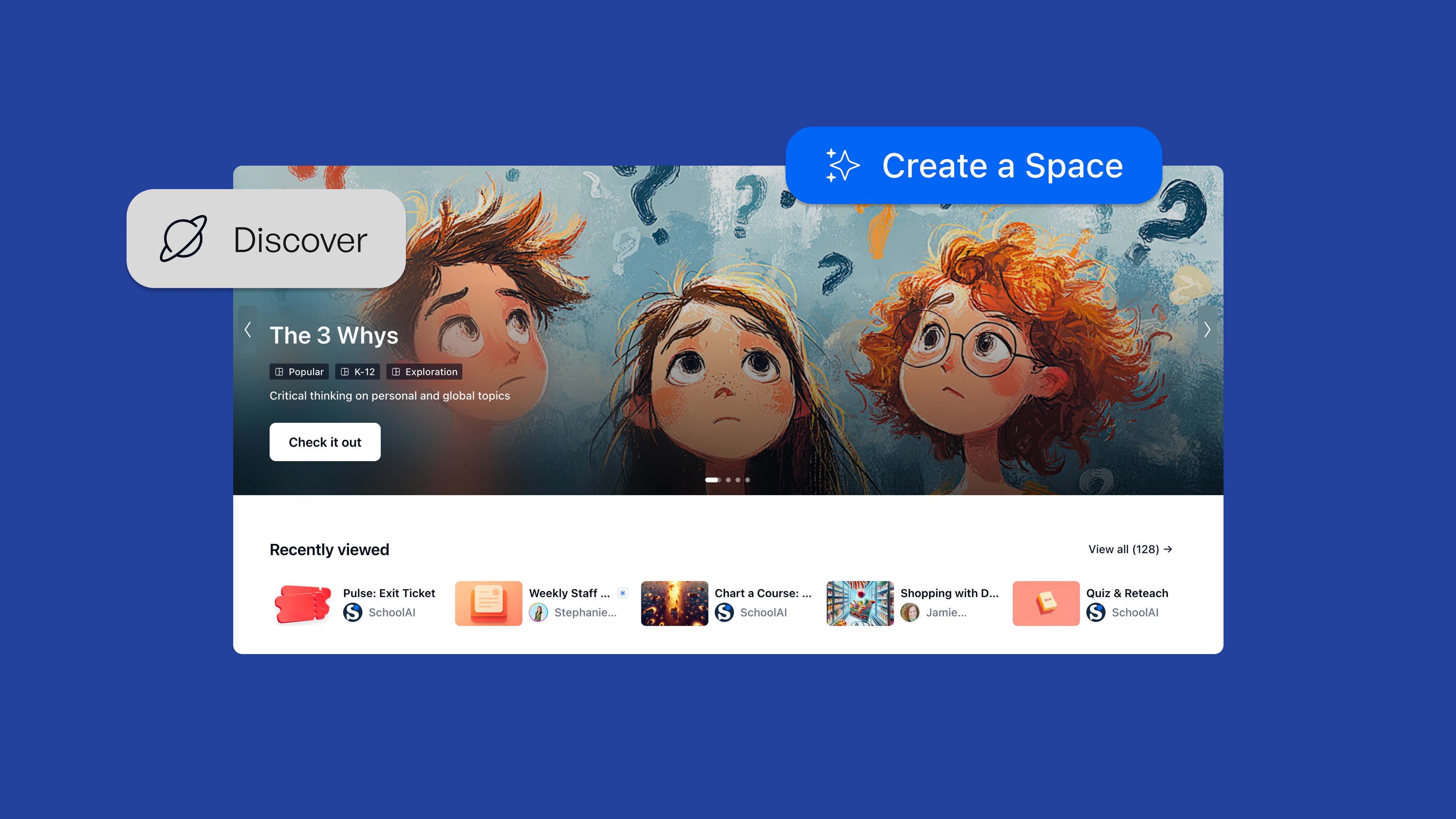
Key takeaways
-
Lack of time to learn new technology is the strongest predictor of teacher resistance to AI across all grade levels, surpassing concerns about student cheating or job displacement
-
Teachers who use AI weekly save an average of 5.9 hours per week, which translates to approximately six weeks reclaimed over a school year
-
Successful schools address teacher concerns about AI before teaching them how to use it
-
Most teachers need 12-18 months to feel confident with AI, so initial hesitation among your staff is completely normal
-
Only 19% of teachers report that their school has clear AI policies, creating uncertainty about acceptable use
If your teachers feel skeptical about artificial intelligence (AI) in their classrooms, they're not alone. Last year, 25% of K-12 teachers said that AI tools do more harm than good, with another 32% reporting mixed feelings.
But here's what's also true: 60% of teachers used AI during the 2024-25 school year, and those who use it weekly report saving approximately six hours every week. But understanding how to support your staff through this transition is critical for successful implementation. Take a look.
Why teachers resist AI: Time constraints, not lack of commitment
When researchers tracked over 9,000 teachers during 2024-25, they found that lack of time was the biggest barrier to AI confidence, more than concerns about cheating or job loss (National Science Foundation).
Think about what your teachers face each week. Between planning lessons for diverse learners, managing IEPs and 504s, grading assignments, responding to parent emails, attending meetings, and actually teaching, when exactly were they supposed to become AI experts?
For example, imagine a fifth-grade teacher in suburban Ohio who spent three weeks trying to learn AI tools. Between supervising her student teacher, attending IEP meetings for seven students, and planning differentiated math lessons, she logged into the AI platform exactly twice before giving up. It wasn't lack of interest, it was lack of time.
Beyond time constraints, teachers face structural barriers that administrators must address:
-
Unclear policies: Only 19% of teachers say their school has clear AI policies (Gallup-Walton Family Foundation), leaving staff without guidelines about acceptable use.
-
Training disconnect: 67% of schools report offering AI training, yet 68% of teachers say they haven't received any (RAND Corporation). Institutional support must make training accessible given time constraints.
-
Resource inequity: Almost all low-poverty districts will have trained teachers on AI by 2025-2026, while only six in ten high-poverty districts will have done so.
Overcoming teacher reluctance toward AI by addressing fear before features
Districts that got AI training right did something counterintuitive: they addressed teachers' worries before showing them any features. The most successful training sessions started with concerns and fears, not technical capabilities (RAND Corporation).
Research has identified key concerns driving educator skepticism about AI in K-12 settings:
-
AI systems perpetuating bias and making unfair recommendations to students
-
Unequal access to AI tools across student populations
-
Difficulty identifying algorithmic biases in AI outputs
-
Students using AI to cheat rather than learn
These aren't technophobic reactions, they're legitimate professional concerns that administrators should validate. This explains why 59% of teachers in Stanford's study abandoned AI tools after minimal engagement. Without addressing underlying concerns, training fails.
For example, imagine an 11th-grade English teacher who initially refused to try AI because he worried about students cheating on essays. His district's training started with a session about detecting AI misuse and designing AI-resistant assignments. Only after those fears were addressed did he experiment with using AI to generate discussion questions.
When selecting tools for your school, look for features that give teachers control: the ability to see every student conversation, pre-set guardrails that prevent students from asking AI to complete work for them, and integration with existing curriculum.
The NEA Task Force spent seven months documenting teacher perspectives. Their finding: successful adoption requires "a multifaceted approach that takes into account educators' concerns, motivations, and needs."
Help teachers earn back hours per week
Teachers who use AI tools weekly save an average of 5.9 hours per week, according to the Gallup-Walton Family Foundation study. This translates to approximately six weeks saved over a full school year that your staff could spend on instruction, planning, or personal time.
For example, imagine a third-grade teacher who started using AI weekly to draft differentiated reading passages. She saves about 45 minutes every Sunday that she used to spend adapting texts for struggling readers.
But here's the critical detail: time savings only materialize with consistent weekly use. Teachers who use AI monthly save only 2.9 hours per week, roughly half the benefit. Building structured time for regular practice is essential.
The largest time savings come from finding educator-created resources for lesson differentiation. Weekly AI users commonly report time savings in lesson differentiation, written feedback, and parent communication.
Addressing teacher AI adoption challenges
Research documents a consistent 12-18 month adoption curve for educators initially resistant to AI technology. Education Week data shows teacher AI adoption dipped from 34% (2023) to 32% (2024) before surging to 61% (2025). Initial hesitation is normal: during months 0-12, adoption often remains low before accelerating as teachers see peer success.
Stanford's research tracking over 9,000 teachers found that 16% were "single-day users" who logged in once and never returned, while 43% were "trial users" with minimal engagement.
As an administrator, don't expect immediate adoption. Give teachers time to explore gradually, see what's working, and build confidence through sustained practice.
Reducing teacher pushback on AI
Ready to help your staff reclaim six hours per week? Encourage them to start with one constrained task where they maintain full visibility.
Here's a framework to share: Pick one class or prep period. Choose one task where AI could save time, such as lesson differentiation or feedback drafting. Try it consistently for one week. Track time spent versus the usual approach. If it saves even 30 minutes, keep going.
SchoolAI's Discover feature provides access to 200,000+ educator-created Spaces designed for lesson differentiation and feedback drafting, giving teachers control over every student interaction while cutting prep time.
Your teachers' concerns about time, student misuse, and unclear policies are legitimate barriers, not personal failings. Provide tools that give them visibility into student work, and give them permission to adopt gradually. Ready to explore AI tools built specifically for teachers? Try SchoolAI today.
Frequently Asked Questions
According to Pew Research Center, 25% of K-12 teachers said AI tools do more harm than good in 2024, with another 32% reporting mixed feelings. However, teacher resistance to AI often stems from lack of time, unclear policies, and insufficient training rather than fundamental opposition to the technology. Notably, 60% of teachers used AI during the 2024-25 school year, suggesting that with proper support, many initially hesitant teachers become adopters.
The 10-20-70 rule provides a framework for AI adoption in education: 10% formal training through workshops and structured professional development, 20% social learning through peer collaboration and mentoring, and 70% experiential learning through hands-on practice and applying AI tools in real classroom situations. This framework suggests that while formal training matters, most teacher AI competency develops through supported practice and peer observation, which aligns with research showing teachers need 12-18 months to feel confident with AI.
Teachers cannot be replaced by AI because education fundamentally requires human connection, emotional intelligence, and adaptive judgment. Teachers build relationships with students, recognize subtle emotional cues, provide mentorship, model ethical behavior, and make nuanced decisions based on individual student needs in real time. Research consistently shows the teacher-student relationship is one of the strongest predictors of student success. AI serves best as a tool that amplifies teacher effectiveness by handling time-consuming tasks so educators can focus on the irreplaceable human elements of teaching.

About the author
Stephanie Howell
Education Specialist at SchoolAI, Former Teaching and Learning Coordinator
Stephanie is a former teaching and learning coordinator with a background in instructional coaching, classroom management, and curriculum development. She holds a master's in educational leadership from Western Governors University. At SchoolAI, she works with schools to lead AI adoption and professional learning, turning new tools into classroom-ready practice that teachers can put to work right away.
Transform your teaching with AI-powered tools for personalized learning
See how every student is doing, and know what to do next.