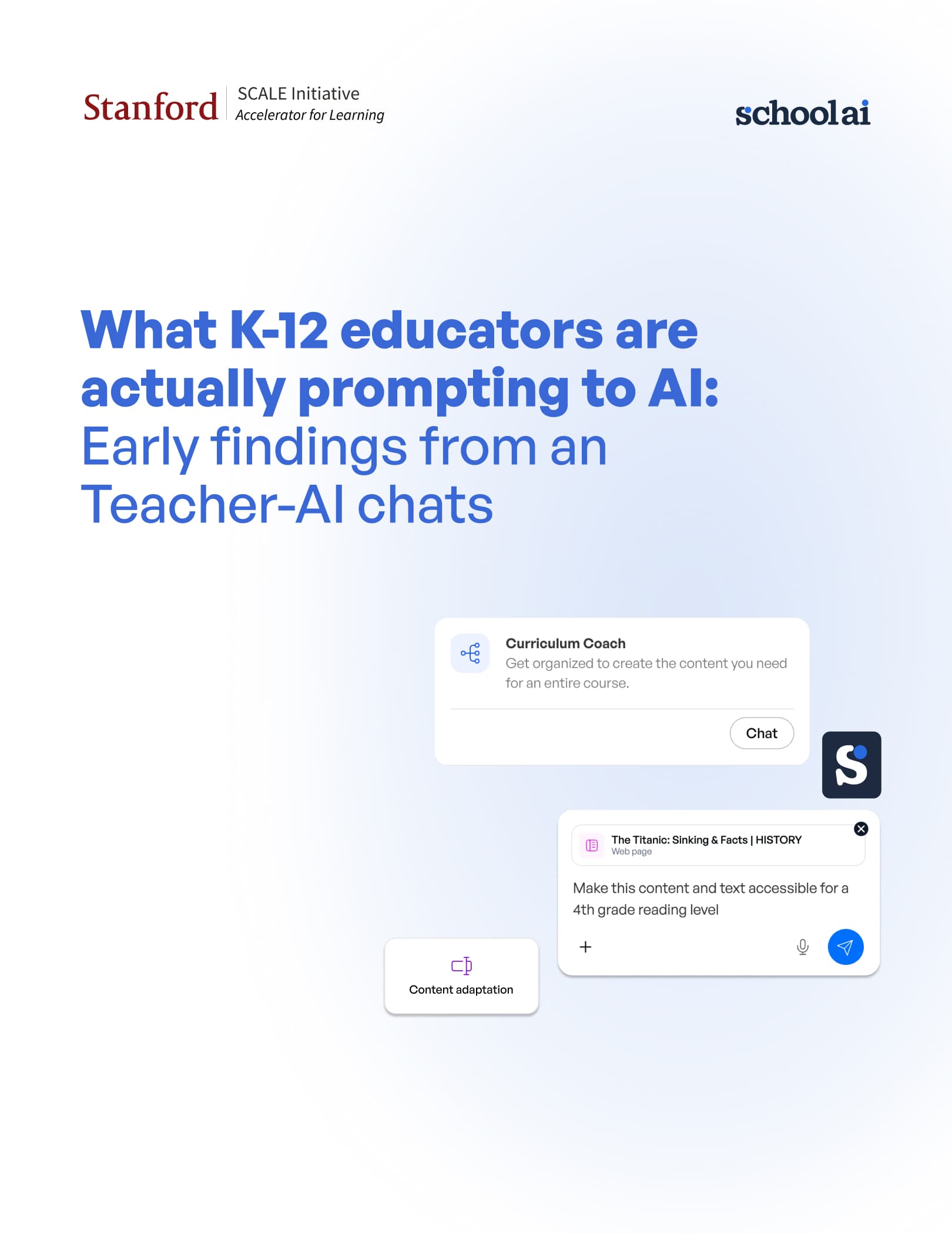
Stanford study analyzes 150,000+ teacher prompts to reveal what educators are really doing with AI tools
Stanford University's SCALE Initiative released the second study in its series on AI in education, analyzing the content of over 150,000 prompts from more than 4,400 K-12 teachers across 15,000+ chat threads. Where the first study tracked behavioral patterns, like logins, feature use, and retention, this research goes deeper, examining what teachers actually say to AI and how they use it in practice.
The findings reveal a clear preference for simplicity. Among teachers who started more than one chat thread, 84% relied on a single AI assistant for all of their interactions. Even among heavier users with four or more threads, 58% used only the general-purpose assistant, Coteacher. Teachers aren't shopping between specialized tools. Instead, they're gravitating toward one versatile partner that can handle the full range of their needs.
Teacher prompts are overwhelmingly action-oriented. Just over half of all messages were classified as "Doing"—requests for AI to generate lesson plans, assessments, feedback, or other materials. Another 31% were "Asking" for information or advice, while 15% were "Expressing" reflections or thoughts. Compared to general ChatGPT users, who primarily ask questions, teachers are using AI as a creation tool built into their workflow.
Curriculum and content dominate the conversation. Roughly two out of every five messages relate to what to teach, how to represent content, or how to align materials with standards. Teachers are using AI as a curriculum co-planner to unpack standards, generate examples, and revise tasks to make them more accessible to students. Assessment and feedback, instructional practices, and student needs round out the remaining use cases.
Perhaps most notably, teachers don't stay in one lane. Within a single conversation, educators move fluidly between curriculum, instruction, assessment, and student needs. A thread might begin with a content-aligned lesson request, shift toward differentiation for below-grade-level readers, and conclude with a parent communication email. This mirrors the reality of teaching itself where content, pedagogy, and student context are constantly interwoven.
These findings reinforce a key insight for education leaders: teachers are using AI for substantive instructional work, not just administrative shortcuts.
The data shows AI functioning simultaneously as a reference tool and a drafting partner within the same conversation, with curriculum quality and standards alignment at the center of how teachers engage.
Read the full Stanford SCALE research to explore the complete prompt analysis, classification framework, and implications for AI tool design in K-12 education.
A study of 1,070 students across 36 schools finds that regular users report stronger engagement, deeper thinking, and more confidence in their future
Read article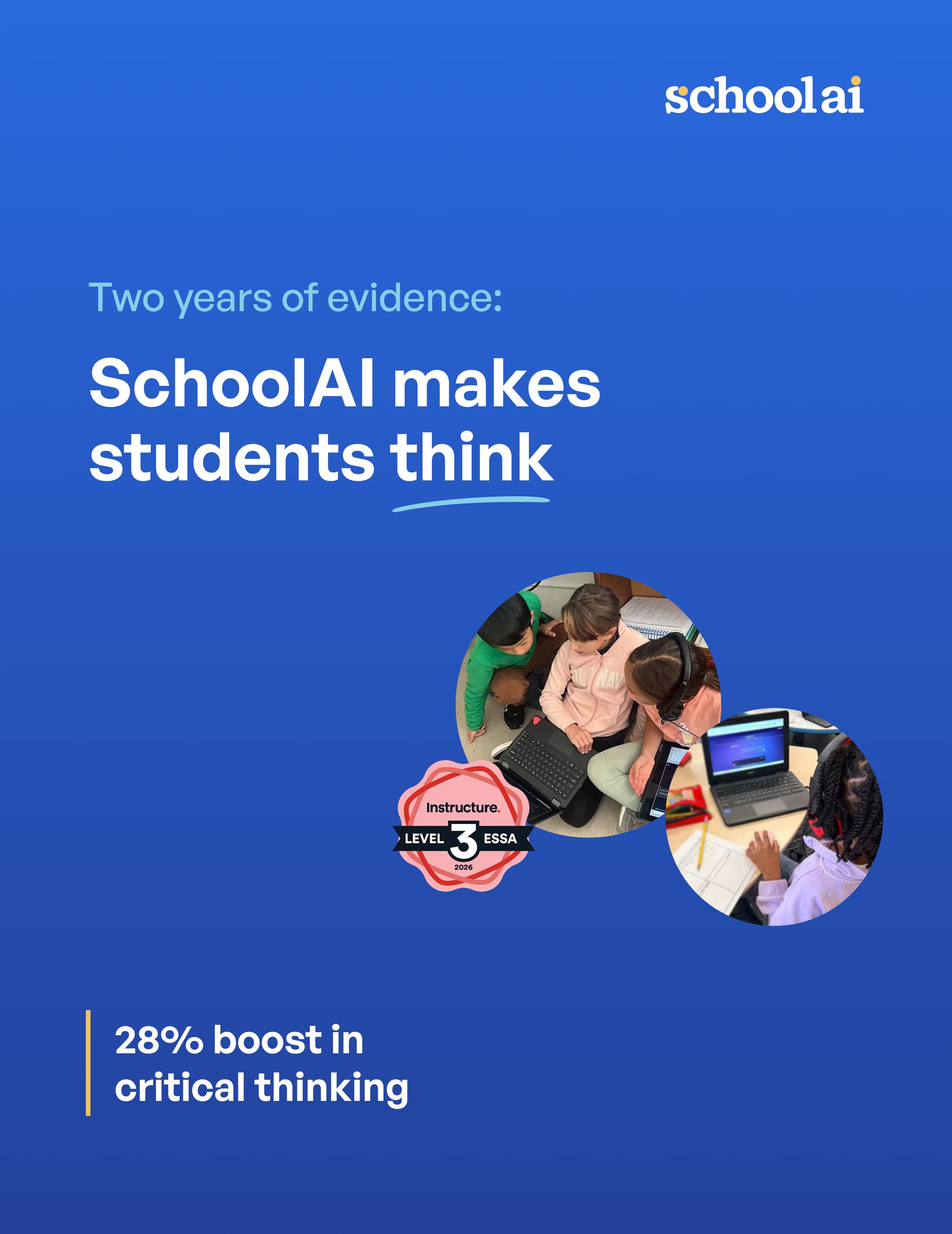
A two-year study of 13,882 student-AI conversations shows a 28% boost in critical thinking and earns ESSA Level III certification.
Read article