AI privacy in education: A teacher's guide to protecting students
Learn how to protect student data when using AI tools in your classroom. Understand FERPA, COPPA compliance, and how to evaluate vendors for AI privacy.
Blasia Dunham • Mar 16, 2026
AI Literacy Safety & Policy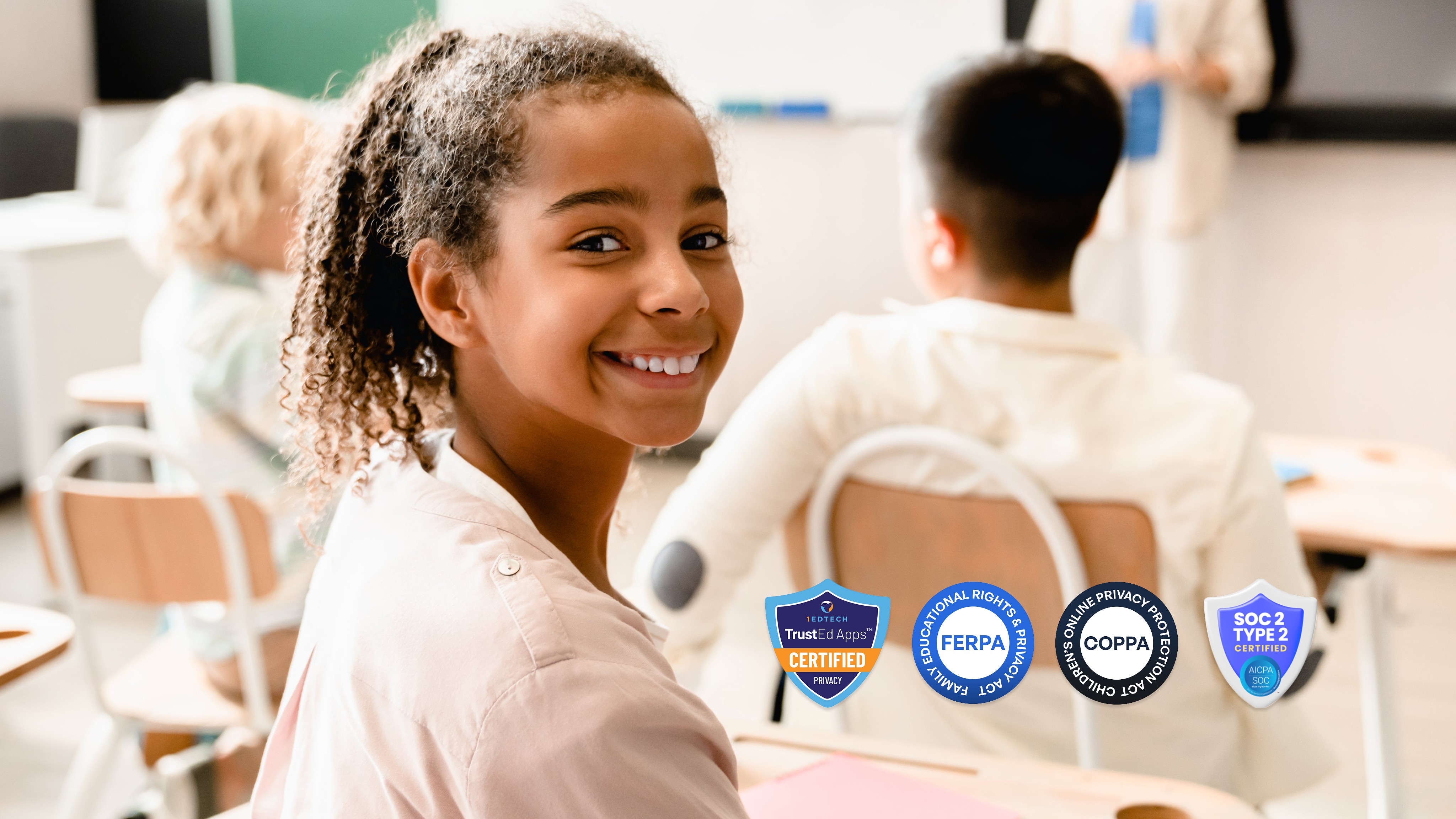
Key Takeaways
-
The FTC's COPPA amendments, finalized in 2025, require separate parental consent for sharing children's data with third parties, though schools can still authorize educational data collection under existing FTC guidance
-
60% of teachers used AI in 2025, but roughly two-thirds received no training from their schools
-
Administrators must verify that AI vendors comply with FERPA and COPPA before using AI tools with students
-
AI tools can retain student inputs indefinitely and use classroom data to train commercial models
-
Before implementing AI tools, check privacy risks and get written proof of vendor data practices
-
Privacy-first platforms like SchoolAI are SOC 2 Type 2 certified, FERPA compliant, and COPPA compliant, ensuring student data is never sold or used to train AI models
What Changed in January 2025 for AI Privacy in Education
If you're using AI tools with students under 13, the rules just got stricter. The Federal Trade Commission strengthened COPPA requirements in January 2025. These changes directly affect which AI tools you can use in your classroom and highlight growing privacy concerns with AI in education.
Here's what's different now. AI companies need separate parent permission before sharing children's information with other companies. They can't collect more information than reasonably necessary for students to participate. They must keep children's personal information secure and maintain effective data retention and deletion protocols.
Schools can give consent for parents when the AI tool supports learning. But that authority comes with real responsibility. You essentially vouch that the tool protects student privacy and doesn't use data for advertising or commercial purposes. SchoolAI maintains full COPPA compliance with proper controls and guardrails, so elementary students can safely explore AI learning.
AI Privacy Issues Examples from Real Classrooms
When students use AI chatbots for homework help or writing support, they often share more than just assignment questions. They mention family situations, personal struggles, and identifying details. According to Stanford HAI researcher Jennifer King, AI developers maintain long data retention periods and frequently train their models on children's data without transparency.
This risk isn't hypothetical. In 2023, Samsung employees leaked sensitive company data by pasting proprietary code into ChatGPT, which then became part of the model's training data. The same thing can happen in classrooms. Stanford HAI research also claims that large language models trained on internet-scraped data "may memorize personal information about people, as well as relational data about their family and friends."
When students paste personal essays containing family financial struggles or mental health details into AI tools, that information could be retained indefinitely and potentially reproduced in outputs to other users.
The training gap makes these concerns worse. Only 48% of teachers have received training from their schools on using AI effectively and safely. Without guidance, teachers unknowingly upload student work samples with identifying information. Platforms like SchoolAI address this by never using student information to train AI models and maintaining complete data transparency.
Questions to Ask Before Using AI Tools with Students
Start with data collection. What specific student information does this tool collect? How long is it retained? Can students or parents request deletion? The vendor should provide written documentation, not general assurances.
Then address legal compliance. Has the vendor signed a Data Privacy Agreement confirming they'll follow FERPA requirements? Do they meet COPPA requirements for students under 13? Check whether your state has issued AI guidance. 33 states have released guidance as of August 2025, and the U.S. Department of Education continues to develop federal frameworks.
Third-party sharing deserves direct questions. Does the vendor share student data with any third parties? Is student input used to train AI models?
SchoolAI takes a different approach: zero advertising, zero data selling, and every partner is contractually bound to these standards. Read more about our privacy policy here.
Security matters as much as legal compliance. What encryption protects student data? What's your breach notification procedure? If a vendor can't provide clear answers, you're taking unnecessary risks with student privacy.
How to Help Students Protect Their Own Privacy
Students need to understand what happens to the information they share with AI tools. This doesn't require complex technical explanations, just clear guidance on what's safe to share and what isn't.
Teach students this practical rule: Never put anything into an AI tool that you wouldn't want appearing in someone else's search results. This means no full names, no addresses, no details about family finances or personal struggles.
Show them how to anonymize their work. Instead of "My mom lost her job and we might lose our house," they can write "A character faces housing insecurity after job loss." The AI provides equally helpful feedback without exposing private family details.
For elementary students under 13, teachers should supervise all AI tool use. This is where SchoolAI's Mission Control becomes essential, letting teachers monitor student interactions in real-time and alert to concerns.
What to Tell Parents About AI Privacy Concerns in Education
Parents want to know three things: what AI tools you're using, what data is collected from their children, and how that data is protected.
Send a clear notification to parents before introducing new AI tools. The notification should include:
-
The tool's name, purpose, and what student information it collects
-
How long data is retained and whether it's shared with third parties
-
Documentation that the school has evaluated the vendor's COPPA and FERPA compliance
For students under 13, clarify that schools can provide consent on behalf of parents for educational tools. Parents retain the right to review what information has been collected, delete the information, and prevent further collection. SchoolAI supports this by ensuring schools maintain complete data ownership with full export and deletion rights.
How to Evaluate AI Tools for Student Privacy and Data Security
When you evaluate AI platforms, look for those that follow the principle of minimization, collecting only what's necessary for the educational purpose you've defined. Student interactions should remain under your control, not used to train commercial AI models or shared with third-party advertisers without proper consent.
Real-time monitoring helps you protect student privacy. Schools should establish protocols that enable you to identify when students share sensitive information during AI tool usage.
When parents ask about safeguards, get written proof from vendors. Ask for documentation of data collection practices, data retention policies, security measures, and third-party sharing disclosures. Look for certifications like 1EdTech that ensure seamless integration with existing systems.
Privacy-Protective AI That Helps You Differentiate
You need privacy-focused AI tools that help you reach every learner while addressing AI privacy in education. SchoolAI's Mission Control feature lets you see student interactions in real-time, so you can identify when students share sensitive information and intervene immediately.
As Nate Sanders, Chief Experience Officer at SchoolAI, explains: "The way that we think about the safety aspect [is that] we ensure that observability and governance is at the forefront of everything, so that a teacher, a principal, is able to observe, see, understand, get critical alerts around every single conversation that happens inside of SchoolAI."
SchoolAI delivers enterprise-grade security with SOC 2 Type 2 compliance, bank-level protection that IT departments actually trust. Student information is never sold or used to train AI models, and every partner is contractually bound to these standards.
Prioritizing AI Privacy in Education
Navigating AI privacy in education requires vigilance, proper vetting, and commitment to student safety. The dangers of AI in education are real when tools lack proper safeguards, but the benefits of AI-powered learning are too significant to ignore.
When selecting AI tools, get written Data Privacy Agreements, verify vendor compliance documentation for FERPA and COPPA requirements, and establish clear policies on data minimization and third-party sharing. For additional guidance, consult frameworks like CoSN's AI Toolkit and Student Privacy Compass.
Ready to use AI that protects student privacy while helping you differentiate for every learner? Try SchoolAI and see how Mission Control keeps student data secure while giving you real-time insights.
Frequently Asked Questions
This is a critical question to ask vendors before adoption. Request documentation about data handling in acquisition scenarios. Quality vendors like SchoolAI ensure schools maintain complete ownership of their data with full export and deletion rights, regardless of company changes. Always get contractual guarantees about data disposal procedures.
Ask vendors directly and get written confirmation. Many free AI tools use all inputs to improve their models. Look for platforms that explicitly state they don't use student data for model training. SchoolAI, for example, never uses student information to train AI models, and every partner is contractually bound to this standard. Check for third-party certifications like SOC 2 Type 2 that verify these claims through independent audits.

About the author
Blasia Dunham
Education Specialist at SchoolAI, Former Technology Integration Specialist
Blasia is a former technology integration specialist who spent years coaching teachers through co-teaching, hands-on training, and one-on-one support. A semi-finalist for AI Educator of the Year, she's known for turning teacher hesitation into confidence. At SchoolAI, she helps educators find their footing with AI the same way she helped teachers find their footing with tech: side by side, one step at a time.
Transform your teaching with AI-powered tools for personalized learning
See how every student is doing, and know what to do next.