How school leaders can use AI insights to improve teaching and learning
Explore AI insights for school leaders, from smarter decisions and efficiency to responsible AI adoption and student outcomes.
Blasia Dunham • Nov 13, 2026
School & District Leadership
School leaders are turning to AI because administrative demands keep growing and student needs shift faster than annual data can show. The most useful AI insights for school leaders have less to do with picking the newest tool and more to do with knowing where AI makes a real difference, how to put it in place responsibly, and how to tell whether it's working.
It takes balancing technology with educator expertise, student privacy, and school priorities, and many school leader concerns about AI come from that tension. This guide covers practical applications, data-informed leadership, responsible implementation, staff readiness, and how to evaluate success.
Key takeaways
-
AI insights matter most when they answer a priority the school already has.
-
Participation data shows activity; evidence of student reasoning shows learning.
-
AI can prepare information for decisions, but people make the consequential calls.
-
Responsible adoption starts with a defined need and a baseline, then policy, a pilot, and regular monitoring.
-
Judge AI by changes in outcomes, workload, and equity, not by how often it gets used.
What AI insights can help school leaders understand?
AI insights for school leaders are actionable information that AI generates or organizes to support instructional planning, operations, resource allocation, and student support. Task-focused AI drafts a family email or summarizes a 40-page policy. Insight-focused uses go further, surfacing learning gaps, recurring misconceptions, emerging needs, and patterns worth a closer look. AI assessment tools are a good example, showing when a whole grade level misreads the same kind of question.
AI earns its place when it addresses a question the school already cares about. A leader who starts with "we need to respond faster when students fall behind in math" can tie AI use to something measurable: instructional responsiveness, administrative hours saved, or how quickly students who need support get identified.
None of this replaces professional judgment. AI output still has to be read alongside what teachers know, each student's context, and other evidence the school collects.
How school leaders can use AI to improve school operations
A principal's day fills up with work that doesn't need a principal. AI can take some of it, freeing time for instructional leadership and staff support.
1. Automate routine administrative tasks
AI can draft newsletters, family communications, agendas, policy summaries, and internal updates. It can also summarize long documents so meetings go to decisions instead of catching up.
2. Support planning and resource allocation
AI can organize staffing, scheduling, and PD information, help leaders compare approaches, and flag questions that need more digging.
3. Strengthen communication and stakeholder engagement
AI can adapt one message for teachers, families, district teams, and the community in plain language, with someone reviewing it for accuracy.
4. Improve decision preparation
AI can synthesize information and lay out benefits, risks, and trade-offs before a decision. It shouldn't independently make consequential decisions about students or staff.
Picture a principal who asks AI to turn her staff meeting notes into a summary with follow-up actions. She checks the draft, catches a concern assigned to the wrong grade-level team, fixes it, and sends it. She saved half an hour and kept responsibility for what went out.
Using AI insights to strengthen instructional leadership
Instructional leadership is where AI adoption matters most, because leaders need to know whether teaching strategies are helping students reach intended outcomes. AI can find patterns in formative assessments, student work, and learning progress that take hours to spot by hand, the core of using classroom data to drive instruction.
Activity and learning aren't the same thing, though. Completion can signal engagement without proving mastery, while evidence of student reasoning and misconceptions shows what students actually understand.
Say a middle school team notices students in five seventh-grade sections treating a ratio as a fraction of a whole. Seeing it across classes instead of in one room, the team plans a common reteach, and the instructional coach builds a short PD session around the misconception. Insights like this should start conversations, surface professional learning needs, and guide support, never serve as a verdict on a teacher's performance. AI for teacher coaching works the same way.
SchoolAI is built around helping teachers respond to individual needs while keeping their autonomy: teachers design the AI learning experiences, and leaders see student thinking instead of just clicks.
How AI can support data-informed school leadership
Schools collect plenty of data, but it lives in separate systems. AI can organize information from multiple sources and surface patterns that might take weeks to find by hand, improving district data visibility across classrooms.
Types of information that can inform leadership decisions
-
Student performance and progress toward learning outcomes, including AI progress monitoring
-
Attendance, participation, and engagement trends
-
Staff feedback, professional learning needs, and operational information
-
Patterns in intervention needs and access to support
Leaders can use these patterns to form questions, set priorities, and judge where extra resources may be warranted, the practical value of AI-supported performance monitoring.
A pattern is only a starting point. Correlation doesn't establish cause, and incomplete or outdated data can point a team the wrong way. A sound process runs in order: AI flags a possible pattern, leaders check it against other evidence, and educators decide the response. Dashboards complement existing data systems and professional judgment; they don't replace them.
Implementing AI responsibly across a school or district
Adoption takes more than a purchase order. Clear priorities, governance, staff preparation, and ongoing evaluation are the basics of managing AI implementation.
1. Identify a specific school or district need
Start with a defined challenge, such as heavy administrative workload or limited visibility into learning progress. Set a baseline and decide what improvement looks like. An AI roadmap for administrative teams helps structure this.
2. Evaluate tools before adoption
Review educational fit, accuracy, accessibility, integration, data practices, and safeguards using an AI evaluation checklist for principals. Confirm the tool meets district policy and legal obligations.
3. Establish clear AI use policies
Define acceptable and prohibited uses, review requirements, and who is accountable for AI-assisted decisions. These school AI policy examples are a useful start. Spell out how confidential information is protected.
4. Pilot the technology and gather feedback
Test in a limited setting with teachers and stakeholders involved, following a clear EdTech pilot process. Judge the pilot on whether it improved the intended process or outcome, since usage numbers alone won't tell you.
5. Monitor and refine implementation
Check accuracy, usefulness, equity, workload, and student outcomes at regular intervals by monitoring AI use across classrooms. Revise policies and training as needs change.
Throughout, name the staff responsible for oversight and make sure everyone knows how to escalate problems. SchoolAI Mission Control supports that oversight with real-time visibility into student learning and classroom activity.
Addressing AI ethics, privacy, and equity in education
Schools carry a higher bar for responsible AI in education because the technology can touch sensitive student information and influence educational opportunities. Leaders should assess four risks:
-
Student data privacy: Personal information, student work, and classroom conversations must follow applicable laws and district policies. Review each tool's approach to student data privacy with AI tools.
-
Bias and equity: AI can produce biased or inaccurate outputs that disadvantage some groups, so leaders should know how to check AI classroom tools for bias.
-
Accuracy and transparency: Summaries and recommendations can contain errors or leave out context.
-
Overreliance on automation: Staff may treat AI outputs as settled without verifying them.
Safeguards should include approved tools, data minimization, access controls, human review, reporting procedures, and regular checks for bias and reliability, all part of managing AI risks in schools. AI should widen access to learning and never judge a student's ability from incomplete data, which is why evaluating AI tools for accessibility and equity belongs in every review.
Telling teachers, students, and families what information is used and where humans stay in charge is the foundation of building parent trust in school AI. Approval isn't one-time; monitoring continues as long as the tool is in use. SchoolAI builds teacher control, student protections, and responsible use in from the start.
Turn AI insights into student impact
Help teachers turn classroom insights into targeted support while keeping learning experiences teacher-directed and guardrailed.
Preparing teachers and staff for AI adoption
Teacher readiness often decides whether AI helps school improvement or adds confusion and work. Much of the teacher resistance to AI leaders see comes from handing staff tools without the skills to use them. Educators and administrators need to:
-
Understand AI's capabilities, limits, and common errors, the basis of building teacher AI literacy
-
Write effective prompts and evaluate outputs, the focus of training teachers on AI prompting
-
Protect student information and follow approved policies
-
Turn learning insights into appropriate instructional responses
One kickoff session in August won't get staff there. The best AI staff training strategies are practical, ongoing, and role-specific, with time for teachers to test tools, share what works, raise concerns, and give feedback.
Leaders set the tone by questioning AI outputs openly, so pushing back feels normal. Measure professional learning by changes in confidence and classroom practice. SchoolAI supports educators through that process.
Measuring the impact of AI on school improvement
Usage shows adoption, but leaders need evidence of real improvement, and a framework for measuring technology impact should cover:
-
Operational efficiency: Time saved on administrative work and the quality of the result.
-
Instructional effectiveness: Progress toward learning outcomes, responsiveness to misconceptions, and usefulness of formative assessment.
-
Staff experience: Educator confidence, workload, satisfaction, and perceived usefulness.
-
Equity and safety: Differences in access, outcomes, and error rates, plus how well safeguards hold up.
-
Implementation quality: Participation, policy compliance, and how often issues need intervention.
Compare results to your baseline, gather teacher and family feedback, and adjust when results fall short. Knowing what to measure in the first month of AI adoption gives you an early read.
Read student outcomes in context, since a rise in scores can't be credited to AI without enough evidence. The strongest initiatives keep getting refined as priorities and technology change, and that's what success looks like for school AI tools.
Turning AI insights into meaningful classroom support
The most valuable AI insights connect operational decisions to what students actually need to learn, pairing efficiency and evidence with teacher expertise, responsible governance, and measurable outcomes. Leaders need to see how AI-supported learning is working, where students struggle, and which responses might help, the visibility that AI progress monitoring provides.
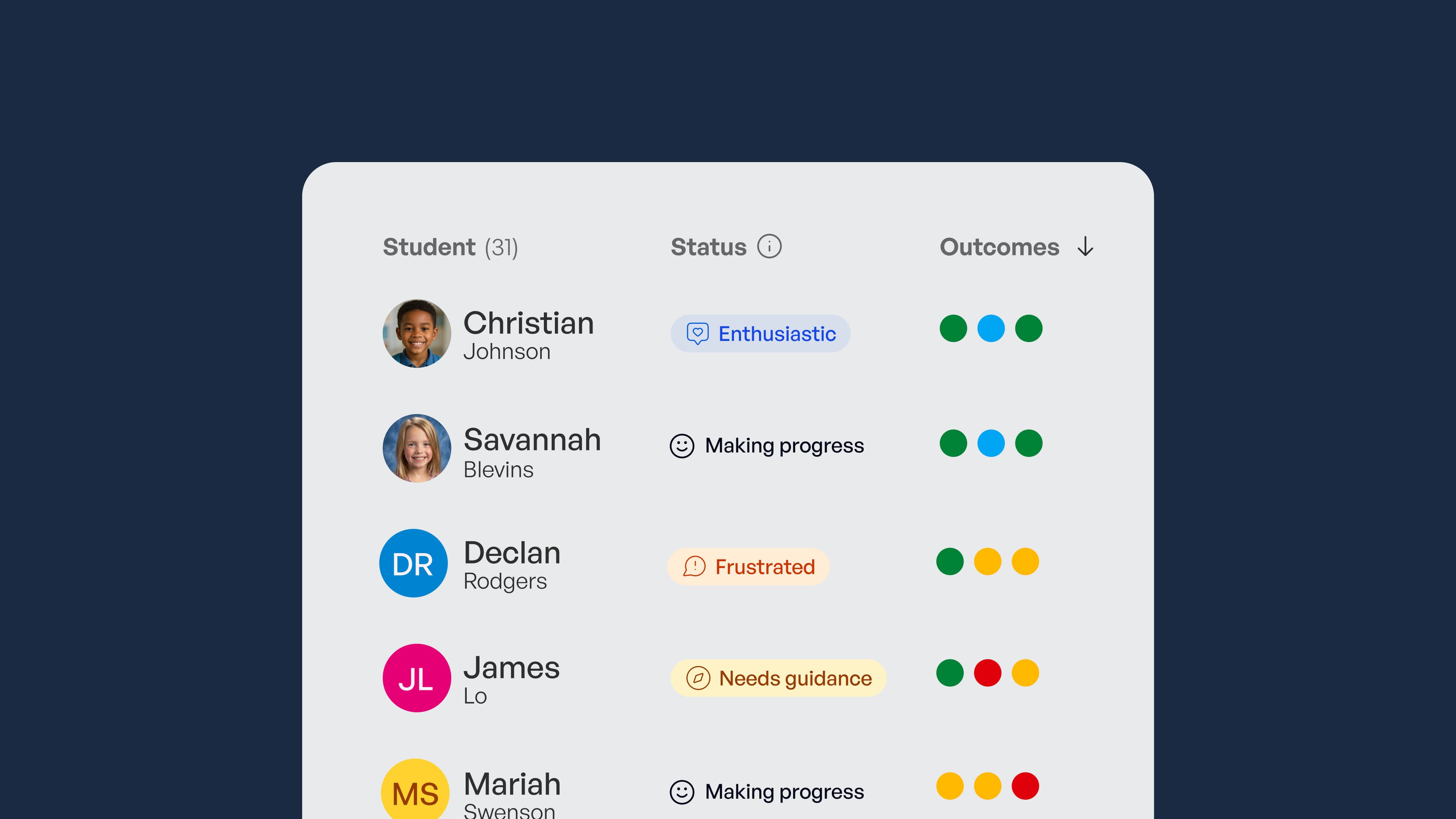
SchoolAI Mission Control puts those principles into practice with real-time classroom visibility, student learning insights, and progress toward learning outcomes. Class mastery, session insights, and Smart Groups help educators spot misconceptions, see who needs support, and plan targeted instruction, so teachers can understand student needs in real time. Because teachers design the experiences and set the guardrails, AI stays tied to instructional goals.
For leaders who want AI adoption to show up as actionable classroom insight and student learning, Mission Control is a practical place to start. Explore SchoolAI Mission Control.

About the author
Blasia Dunham
Education Specialist at SchoolAI, Former Technology Integration Specialist
Blasia is a former technology integration specialist who spent years coaching teachers through co-teaching, hands-on training, and one-on-one support. A semi-finalist for AI Educator of the Year, she's known for turning teacher hesitation into confidence. At SchoolAI, she helps educators find their footing with AI the same way she helped teachers find their footing with tech: side by side, one step at a time.
Bring SchoolAI to your whole school or district.
See how every student is doing, and know what to do next.