Developing an effective AI strategy for school districts
Develop an effective AI strategy for school districts with guidance on governance, professional development, and implementation.
Blasia Dunham • Nov 20, 2026
AI Literacy Safety & Policy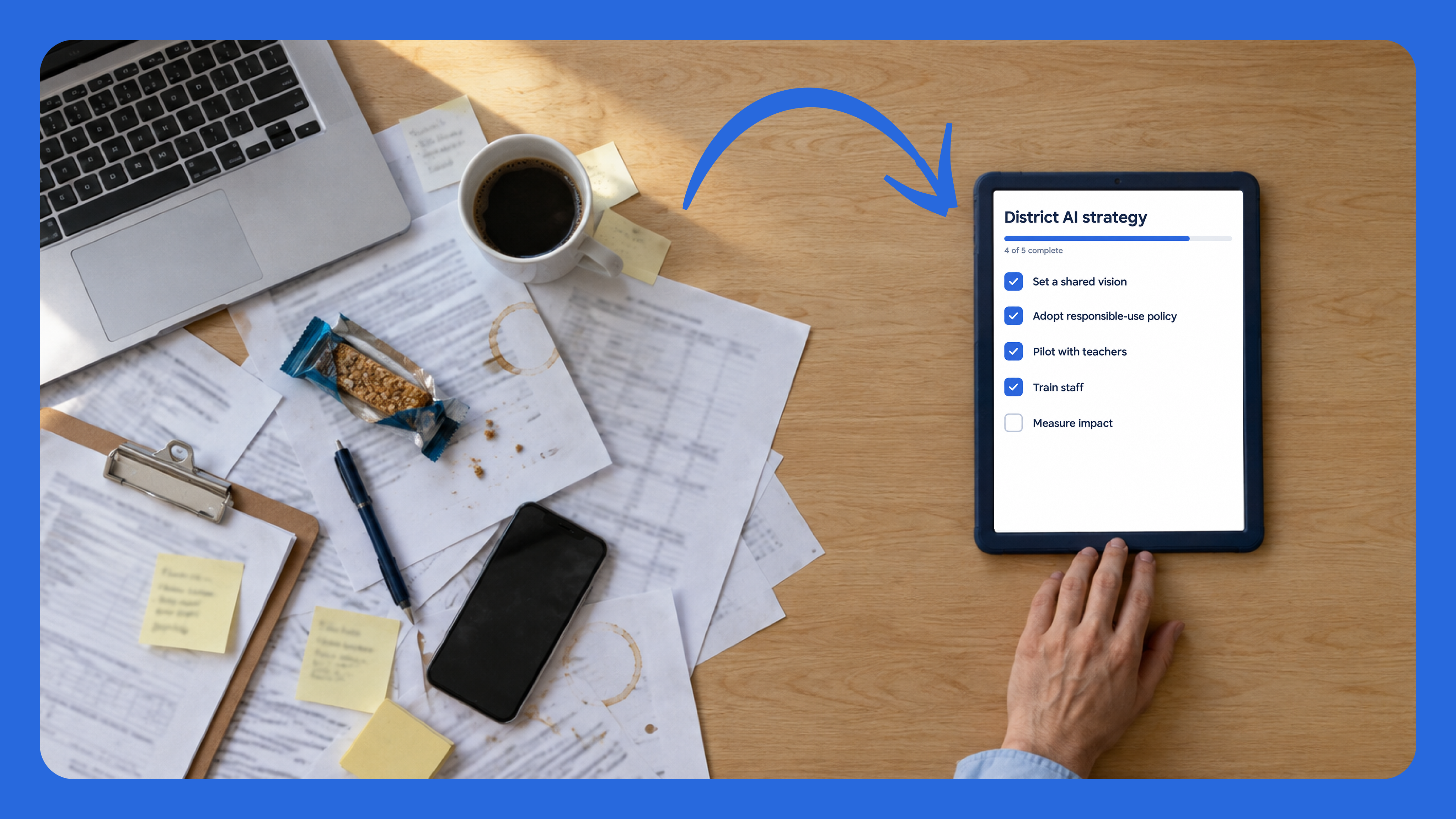
AI is already in your district. Teachers use it to plan lessons and draft parent emails, students use it for homework, and someone in the business office is probably writing reports with it. Most of that started without a plan, and it shows: uneven classroom practice, student data going to vendors nobody vetted, duplicate licenses, and teachers who aren't sure what they're allowed to do.
A district-wide AI strategy ties those decisions back to the goals you already have. The good ones cover governance, professional learning, classroom use, budget, and measurable results, and they don't treat AI as one more initiative stacked on teachers' plates.
Key takeaways
-
Connect AI to the instructional goals your district already has, so it supports existing work instead of competing with it.
-
Settle responsible-use policy before you train staff.
-
Teacher cohorts that learn, try, and share together build AI literacy faster than one-off PD days.
-
Pilot in representative classrooms, then scale what works.
-
Measure learning outcomes and teacher workload, not just logins.
Why school districts need a district-wide AI strategy
In most districts, AI use got ahead of policy a while ago. Teachers found tools that helped, principals made their own calls, and the central office is catching up.
A district-wide strategy sets shared expectations while leaving teachers room to make choices for their own students. It cuts down on overlapping purchases when you're adding AI tools to your existing technology. It sets one standard for student data and responsible AI in education. It keeps spending pointed at district priorities instead of whatever trended at the last conference, and it gives families and staff a reason to trust the process, which is most of the work of building parent trust around AI.
A strategy that only raises adoption numbers hasn't done its job. The point is better learning.
Establish a clear AI vision and align it with district goals
Start with what you're already trying to accomplish. If your strategic plan prioritizes early literacy, MTSS, or SEL, your AI vision should be about those things. Teachers can tell the difference between a tool that moves their work forward and one bolted on top of it.
Then name specific places AI can help, like personalized practice, faster feedback, or fewer hours lost to paperwork. Get your superintendent, technology director, curriculum leaders, principals, and board on the same page early, because a vision only one department believes in won't last. Plan for the long view too, including AI literacy and the future of work your students are heading into.
Questions district leaders should answer
-
Which educational challenges could AI help address?
-
What student and educator outcomes should AI support?
-
Which decisions should be made centrally, and where should schools have flexibility?
Develop AI governance, policies, and responsible-use guidelines
Your policy should define acceptable AI use for students, teachers, administrators, and staff. School AI policy examples are a good starting point. Cover these areas:
-
Student data privacy and security, including FERPA and COPPA compliance for school AI
-
Data ownership, vendor practices, and whether student data trains AI models (look for AI tools with student privacy protections)
-
Accuracy, bias, and transparency, with a plan for checking AI classroom tools for bias
-
AI academic integrity and disclosure of AI help
-
Human oversight when using AI to support school decision-making
Say plainly that AI can help teachers without replacing them or their judgment.
And get this done before training starts. I've walked into full-day PD sessions where staff had never heard the district's position on AI, and the first hour went to questions nobody in the room could answer. Revisit the policy regularly, since managing AI risks in education changes as fast as the tools do.
Identify strategic AI applications across teaching, learning, and operations
Start with problems you already have. Where are teachers losing time? Where are students waiting too long for help?
Classroom instruction and student learning
AI can respond to each student's progress, which makes using AI to personalize learning realistic in a class of 30, and AI tutors for differentiated instruction give students practice and feedback between teacher check-ins. Teachers should design these experiences, setting the objective and the AI guardrails that keep students on task.
Educator and administrative workflows
For staff, quick wins include AI lesson planning, parent communication, and reducing teacher busywork with AI. District teams get better reporting and district data visibility across classrooms.
Rank each possible use by educational value, feasibility, and fit with district goals. Novelty doesn't make the list.
Build AI literacy through professional development and student education
A login doesn't make anyone ready. People need to know what AI does well, where it falls short, and how to question it.
Prepare educators and district staff
One-off PD days rarely stick. Cohorts work better: a group of teachers who meet regularly, try something between sessions, and come back to share what happened. Tie each cohort to a goal the district already cares about, like writing feedback or small-group intervention, and AI becomes part of that work instead of a separate track. Use proven AI staff training strategies and keep building teacher AI literacy around spotting inaccurate output. Over time, cohorts grow into AI professional learning communities whose members train the next group. That's the model behind SchoolAI's Classroom Collaborative, a free monthly train-the-trainer meetup.
Develop student AI literacy
Students need age-appropriate lessons on how AI works and where it gets things wrong. Teach the AI literacy skills students need alongside source evaluation and integrity, using strategies for teaching AI literacy in the classroom, and connect them to AI career skills for students. Teachers should adapt these lessons to their students, and SchoolAI's AI Readiness resources can help.
Create an implementation plan with resources and stakeholder involvement
Turn priorities into a phased plan with owners, timelines, and resources. Districts scaling AI tools in K-12 well almost always go in stages.
Key implementation steps
-
Assess current AI use, infrastructure, and staff readiness to build schoolwide AI readiness.
-
Choose high-priority uses and tools that meet your security requirements, using these questions to ask before adopting AI.
-
Pilot in representative schools or classrooms.
-
Provide training, tech support, and an easy feedback channel.
-
Expand what works and refine policies as you go.
Budget beyond licenses for infrastructure, PD, support, and maintenance. Bring teachers, students, families, IT, and community members in early, since people support what they helped build. And name AI champions in each building. Teachers trust a colleague down the hall more than a vendor, which makes champions key to improving teacher adoption.
Bring Your District's AI Strategy to Life
Empower educators with safe, personalized AI learning experiences and real-time insights into student mastery.
Measure AI impact and continuously improve the strategy
Usage numbers tell you people logged in, not that students learned more. Set indicators that show real impact.
Key areas to evaluate
-
Student outcomes and mastery, by tracking classroom progress with AI
-
Teacher time savings and workload
-
Adoption across schools, starting with what to measure in the first month of AI adoption
-
Equity of access and outcomes, guided by evaluating AI tools for accessibility and equity
-
Policy compliance and data protection, including how districts monitor EdTech use
-
Costs and return on investment
Combine teacher feedback, usage data, and student performance to see what's working, and schedule regular reviews so leaders can adjust policy, PD, and spending.
Turn your district's AI strategy into meaningful student outcomes
Picking tools is the easy part. Lasting adoption comes from a shared vision, clear governance, prepared teachers, real stakeholder input, and honest evaluation. Districts need central oversight, and teachers need room to design learning that fits their students.
SchoolAI is built for that balance. District leaders manage AI and set guardrails across every school, while teachers build guided Spaces for students and see real-time mastery data showing whether students are reaching the learning goals. See how SchoolAI can help your district manage AI adoption with student learning and safety at the center. Request a demo

About the author
Blasia Dunham
Education Specialist at SchoolAI, Former Technology Integration Specialist
Blasia is a former technology integration specialist who spent years coaching teachers through co-teaching, hands-on training, and one-on-one support. A semi-finalist for AI Educator of the Year, she's known for turning teacher hesitation into confidence. At SchoolAI, she helps educators find their footing with AI the same way she helped teachers find their footing with tech: side by side, one step at a time.
Bring SchoolAI to your whole school or district.
See how every student is doing, and know what to do next.