Managing AI risks in education: A practical guide for schools
How to manage AI risks in education, from data privacy to academic integrity, with guardrails that protect students.
Blasia Dunham • Oct 22, 2026
AI Literacy Safety & Policy
Students already have AI in their pockets. Most have used a chatbot for homework whether or not their school has a policy about it, so keeping AI out of school isn't a realistic option anymore. The question now is how to manage the risks that come with it. That means making room for tools that help while protecting the things school exists to build: student growth, student data privacy, and academic integrity. The risks are pedagogical, ethical, legal, and technical, which is why no single fix covers them. A ban doesn't, and neither does an AI detector. This guide walks through the five biggest risks, six practical strategies for classrooms and districts, how to build governance that holds up, and a checklist of questions to ask before approving any tool. It's written for teachers, school leaders, and district administrators who need guardrails they can put in place this semester.
Key takeaways
-
Banning AI doesn't remove the risk; it moves student use somewhere teachers can't see it.
-
AI detectors are unreliable and unfairly flag multilingual writers, so grading the learning process is a safer integrity strategy.
-
Every AI tool should pass a privacy review that covers FERPA, COPPA, state law, and a commitment not to train models on student data.
-
Grades, discipline, and placement decisions need human review before any AI output counts.
-
The safest classroom AI is AI that teachers can shape, see into, and measure.
Why managing AI risks in education matters now
Walk down any high school hallway and you'll find students using general-purpose chatbots, sanctioned or not. That's shadow AI: tools running outside any policy, data agreement, or teacher view. Banning AI outright doesn't make the problem go away. It pushes use out of sight and leaves students to work out responsible use on their own, usually at 11 p.m. the night before something is due. Schools also carry real exposure here, from privacy obligations to students and families, to liability when an automated decision turns out to be biased or wrong, to their responsibility for student well-being.
The major frameworks agree that avoidance isn't the answer. UNESCO's guidance on generative AI in education calls for a human-centered approach in which AI supplements the educator and never replaces them. The U.S. Department of Education's 2023 report on AI and the future of teaching and learning makes the same case for keeping humans in the loop, and the Brookings Institution organizes its framework around three goals: prosper, prepare, and protect. Read together, they treat risk management as the thing that makes AI's benefits safe to pursue. Personalized support, time back for teachers, and faster feedback are all on the table once the guardrails are in place.
The biggest AI risks in education
The risks fall into five categories, and each one calls for a different kind of guardrail.
Loss of critical thinking and over-reliance
When students use general-purpose AI without supervision, it's easy to copy the final answer and skip the concept underneath it. Research cited by Edutopia links that kind of use to lower test scores and weaker long-term recall. An AI that instantly writes the essay or solves the equation also skips the productive struggle, that uncomfortable stretch where a student wrestles with an idea and actually learns it. Over time you end up with students who write excellent prompts but think shallowly, and foundational skills that never get built.
Academic dishonesty and unreliable detection
Students can use AI to write an essay or finish a problem set, bypassing the drafting and reasoning the assignment was designed to build. Plenty of schools have reached for AI detectors as the answer, and the evidence says they shouldn't lean on them. A 2023 Stanford study by Liang and colleagues, published in Patterns, found that popular GPT detectors frequently flagged authentic essays by non-native English writers as AI-generated. A false accusation damages the trust between a student and teacher, and it falls hardest on multilingual learners who are already working twice as hard to be heard. That's why detecting AI writing makes a shaky foundation for any integrity policy.
Student data privacy and security
AI platforms can collect sensitive information (grades, engagement patterns, behavioral responses, the full text of student chats), often without clear consent. Some black-box vendors feed student inputs back into public models to train commercial systems. That creates compliance exposure under FERPA, COPPA, and state student privacy laws, plus real security risk if the data is ever breached. AI-powered monitoring adds another layer, since surveillance tools that aren't carefully governed can infringe on student rights. Our guide to AI privacy in education goes deeper on what to watch for.
Algorithmic bias and inaccurate outputs
AI models learn from historical text, so they absorb its biases and can misread writing that doesn't follow standard conventions. A 2024 study in Nature by Hofmann and colleagues found that language models associated speakers of African American English with more negative judgments than speakers of Standardized American English. Models also hallucinate, stating wrong information with total confidence, and students may accept it without checking. When AI is used for grading, placement, or counseling, these flaws can quietly reinforce the inequities schools are trying to close. These examples of algorithmic bias in education show how it plays out.
Social-emotional risks and isolation
Always-on conversational AI can start to crowd out the peer and teacher interaction students need for emotional development. Some students form dependent, even compulsive, patterns with chatbots, which raises real well-being concerns. The risk runs the other way too. When teachers over-automate feedback and lesson planning, they can lose the human attention and relationships that often keep a struggling student showing up.
AI your students can use safely
SchoolAI puts teachers in control with guardrailed AI experiences, built-in privacy protections, and real-time mastery data.
6 practical strategies for managing AI risks in schools
Each strategy below maps to one or more of the risks above, and together they form a layered defense.
1: Set clear, granular AI use policies
Start by defining when AI is allowed and when it isn't. Brainstorming, language translation, and feedback on a draft might be fair game, while final drafting and exams stay off-limits. Make the rules specific at the course or assignment level, because a single schoolwide rule rarely fits both AP Chemistry and ninth-grade English. A simple traffic-light model works well: red for no AI, yellow for AI-assisted, green for AI-encouraged. When every assignment carries a color, students stop guessing and teachers stop arguing about gray areas after the fact. These school AI policy examples are a good place to start.
2: Redesign assessments around the learning process
If the polished final product is the only thing that gets graded, AI makes it easy to fake. Grade the process instead, including drafting milestones, revision histories, and short reflection notes on what changed and why. Teachers on Reddit's r/Teachers describe leaning on formats that are harder to outsource, like handwritten in-class essays, locked-screen forms, and oral defenses where students explain their thinking out loud. Process-based grading also takes pressure off unreliable detectors and lowers the odds of a false accusation. Once you've watched a piece of writing develop, you don't need software to tell you who wrote it.
3: Vet every AI tool before it reaches students
Every piece of educational software should go through a formal review for FERPA, COPPA, and state privacy compliance before students touch it. Require data minimization, clear retention and deletion terms, parental consent protocols, and a contractual commitment that student data won't be used to train models. Give IT the visibility to filter unsanctioned AI tools at the network level, which cuts down on shadow AI. If a vendor can't answer these questions plainly, that tells you something. SchoolAI publishes its own answers on our trust site, and every vendor should be able to show you the same. Here's more on AI tool safety in education.
4: Keep humans in charge of high-stakes decisions
Grading, discipline, placement, and college and career tracking should never rest solely on automated output. Require human review of any AI-generated recommendation that touches a student's record. When AI does inform a decision, favor forward-looking data like student goals and demonstrated skills over trailing demographic factors, which can carry bias straight into the result. A person who knows the student should always have the final word.
5: Choose AI that teaches, not tells
The difference between helpful and harmful AI often comes down to whether it hands students the answer. Tutor-style tools act as a Socratic guide, asking probing questions, scaffolding reasoning, and declining to produce the finished essay. When teachers configure the AI, the productive struggle stays intact and students still get support when they're stuck. Roleplay simulations and targeted feedback are especially strong use cases, since both require students to do the thinking. Here's how AI guardrails keep students safe and learning on track.
6: Build AI literacy for teachers and students
Teachers need training to spot hallucinations, recognize biased feedback, and redesign lessons around the human relationships AI can't replace. Students need to learn to question AI output, check claims against reliable sources, and understand how models get things wrong. Fold in digital citizenship as well: what data AI tools collect, when using AI makes sense, and how to disclose AI use honestly. Building AI literacy on both sides of the desk is what makes every other strategy on this list hold. If you need a place to start with students, SchoolAI's student AI literacy content on the Learning Hub is built for exactly that.
How to build an AI governance framework that lasts
Classroom strategies only hold up with institutional backing behind them. A district-level governance structure keeps policy consistent from one building to the next and accountable over time. The Brookings Institution framework recommends co-creating AI guidelines with teachers, students, and parents, so the rules reflect how AI is actually used in classrooms and people are more likely to follow them. Ownership needs a home, too. A cross-functional AI committee with members from curriculum, IT, legal, and student services can approve tools, update policy, and field concerns as they come up (this guide to managing AI implementation in schools covers how to set one up). That committee should also own vendor accountability by making sure contracts spell out data ownership, breach notification, and audit rights.
Families deserve to hear about AI from the school before they hear about it from their kids. Tell them which tools are approved, what data those tools collect, and how parents can opt out or ask questions. Then treat governance as continuous improvement rather than a policy you write once and file away. Review usage data, policy outcomes, and new research every semester, since AI tools and privacy laws both change quickly. Through all of it, keep UNESCO's principle at the center: AI should serve human agency, which means protecting in-person classroom interaction and building regular well-being checks for students into the plan.
Questions to ask before approving an AI tool
Use these questions in procurement reviews or before trying a new tool in class.
-
Does the vendor sign a student data privacy agreement and comply with FERPA, COPPA, and applicable state laws?
-
Is student data used to train the vendor's AI models, and can the district request deletion?
-
Can teachers set boundaries on what the AI will and won't do, such as refusing to write a full essay?
-
Does the tool guide students toward answers with questions and hints, or simply supply them?
-
Do teachers get visibility into student conversations and learning progress?
-
Are high-stakes outputs like grades, flags, and recommendations reviewed by a person before they count?
-
Has the vendor shared how it tests for bias and accuracy, and how it handles harmful or off-topic requests?
Managing AI risks without losing AI's benefits
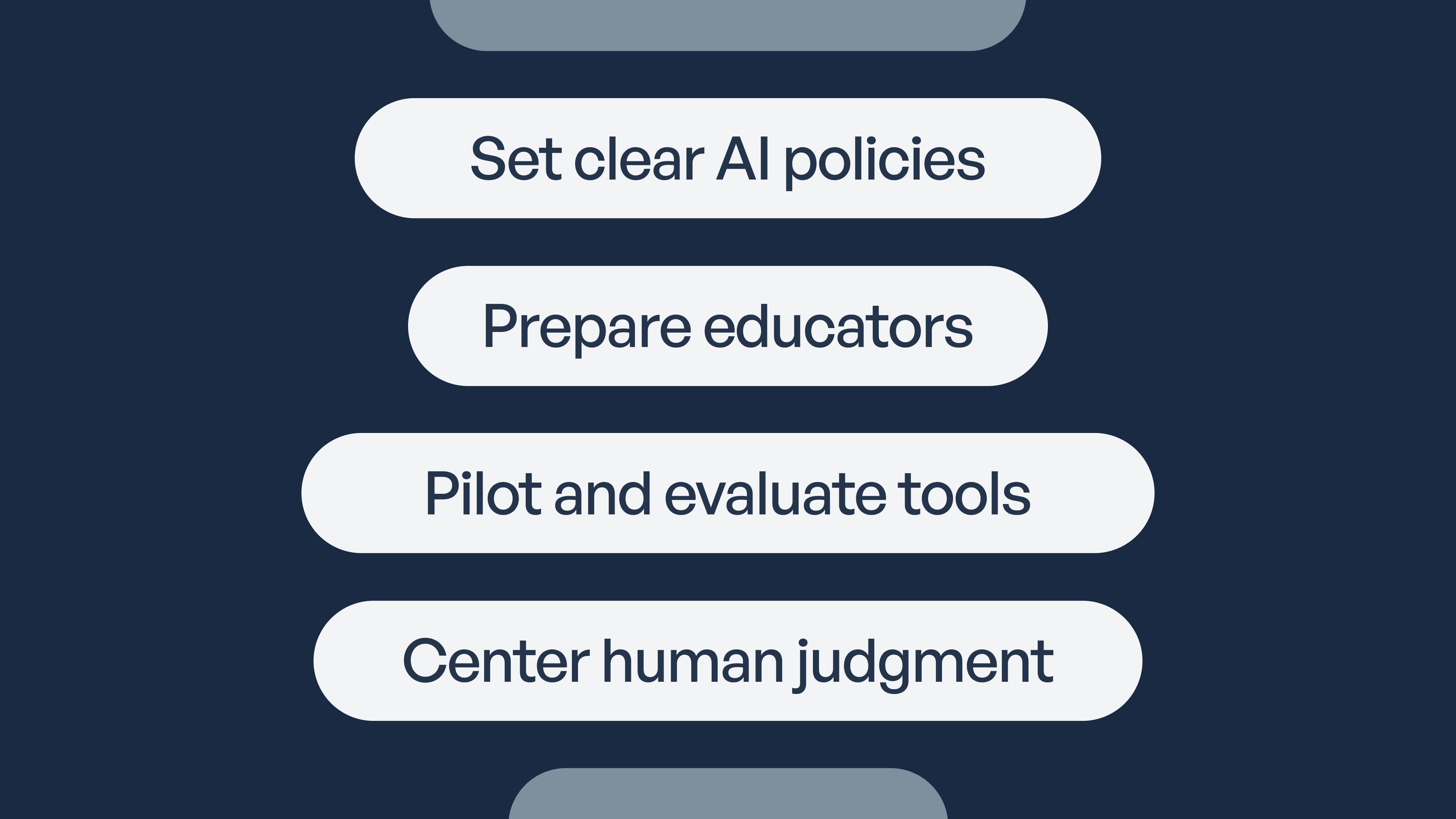
Managing AI risk in schools doesn't mean avoiding AI. It means pairing clear policies, process-based assessment, careful vetting, human oversight, and AI literacy so students keep building real skills. If there's one through-line, it's that the safest AI in a classroom is AI that teachers can shape, see into, and measure. Many of these guardrails are also easier to maintain when they're built into the tool itself instead of bolted on through policy alone.
SchoolAI gives schools safe, classroom-ready AI where students learn inside teacher-designed, guardrailed experiences. With Spaces, teachers set the boundaries, goals, and tone of each AI interaction, so the AI guides students through the thinking instead of handing over answers. Teachers can also see every student conversation inside a Space, so AI use happens in the open instead of in a browser tab nobody's watching. Mission Control gives educators real-time mastery data that shows whether students are reaching the outcomes that matter and flags who needs support. Teacher-set guardrails address over-reliance and integrity, built-in privacy protections address data risk, and live visibility keeps humans in charge. Request a demo to see how SchoolAI helps your school adopt AI with confidence.

About the author
Blasia Dunham
Education Specialist at SchoolAI, Former Technology Integration Specialist
Blasia is a former technology integration specialist who spent years coaching teachers through co-teaching, hands-on training, and one-on-one support. A semi-finalist for AI Educator of the Year, she's known for turning teacher hesitation into confidence. At SchoolAI, she helps educators find their footing with AI the same way she helped teachers find their footing with tech: side by side, one step at a time.
Transform your teaching with AI-powered tools for personalized learning
See how every student is doing, and know what to do next.