Using AI to support school decision making
Learn how schools can use AI for smarter decisions about teaching, student learning, school policies, and student safety.
Blasia Dunham • Nov 2, 2026
AI Literacy Safety & Policy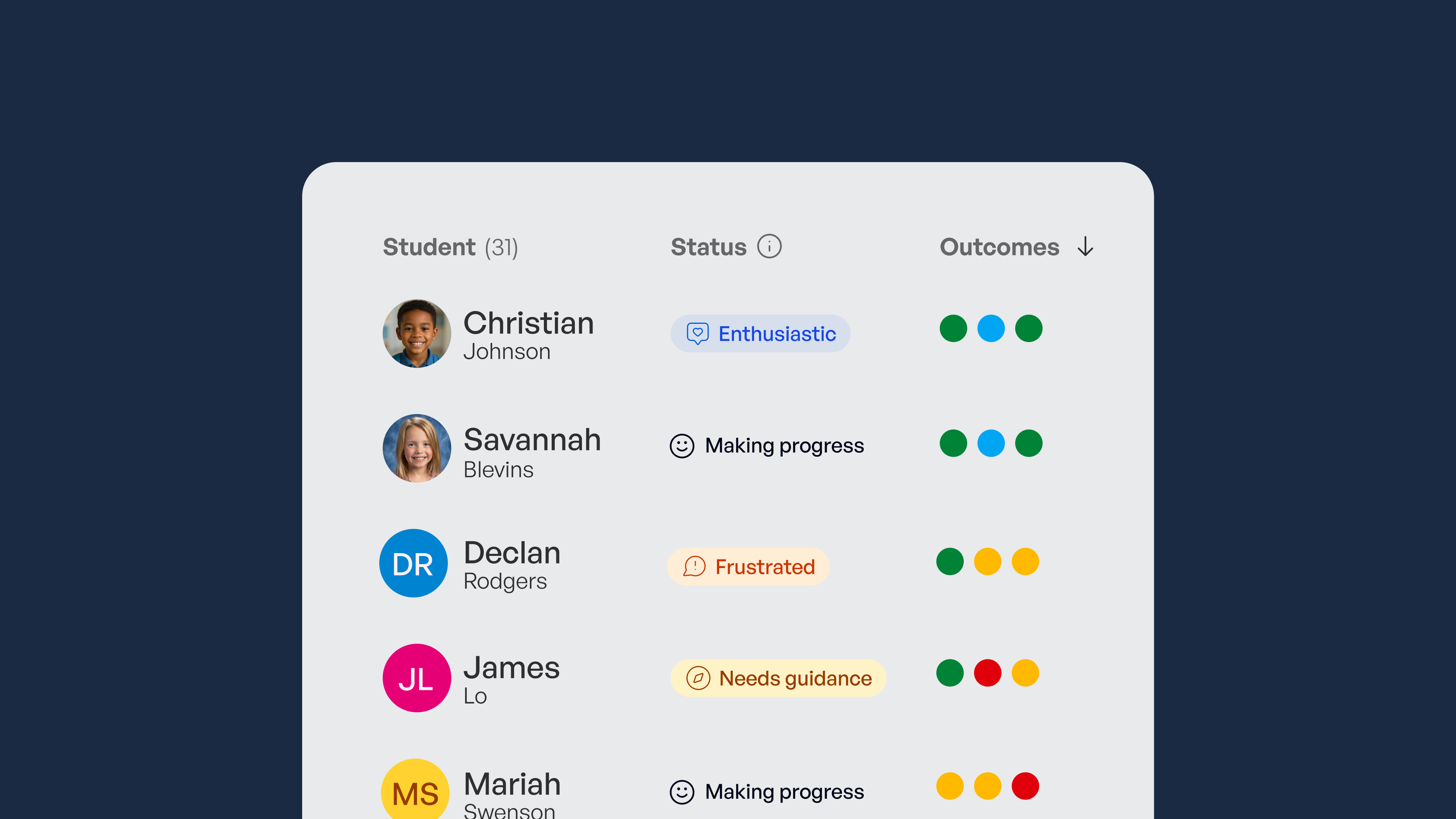
Using AI for school decision making means using AI tools, data, and the insights they surface to inform choices about teaching, learning, school operations, and student support. A teacher is deciding which six students need a reteach on Thursday, while a district team weighs whether last spring's pilot earned a second year. AI can speed up both calls by spotting patterns in work no one has time to read line by line, personalizing support, and laying options side by side. It shouldn't make the call, though. The best tools help teachers without replacing them, and the same holds for principals and district leaders.
That's why responsible AI in education starts before anyone opens a dashboard. Student privacy, fairness, transparency, academic integrity, and human oversight all determine whether an AI-informed decision holds up when a parent or board member asks how it was made. Good decisions still depend on a clear goal, information you can trust, educators who know the students, and a plan to check whether the decision worked.
Key takeaways
-
AI works best as a source of evidence for decisions about instruction, intervention, and planning, while educators keep the final say.
-
Every AI-generated pattern is a starting point for investigation, so check it against original records and what teachers know about their students.
-
Student data can be used safely when it stays inside approved platforms built for schools, with clear rules on collection, storage, and model training.
-
Clear policies, ongoing AI literacy training, and phased implementation do more for good decisions than any single tool.
-
Measure success by learning outcomes and decision quality, not adoption rates or time saved alone.
What schools can use AI to make decisions about
AI can support decisions at almost every level of a school system, from what happens in third period tomorrow to how a district spends next year's professional learning budget. At every scale, it helps educators see a need sooner and choose a next step with better evidence. A solid district AI strategy names these decision areas up front so tools get chosen for a reason.
Instructional planning and classroom support
AI can help teachers adjust lesson difficulty, reading levels, and practice activities so one objective reaches students at different starting points, which is the heart of using AI to personalize learning. It can flag misconceptions as students work, so a teacher can decide whether the class needs reteaching, enrichment, or more practice; strong checking for understanding habits pair well here. Over a unit, using classroom data to drive instruction shows which strategies landed.
Student progress and intervention
The earlier a gap shows up, the easier it is to close. AI progress monitoring can surface students who need support weeks before a unit test would, and that evidence can guide small-group work inside a Response to Intervention (RTI) framework. Still, a teacher knows when a student's scores dipped the week her family moved. Reliable AI for student progress tracking combines AI insights with teacher observations, assessment results, and knowledge of each student's circumstances.
School and district planning
Leaders can use AI to evaluate technology adoption, professional development needs, and program effectiveness. Login counts alone can't tell if edtech is working, so better evidence matters at renewal time. Aggregated data can also reveal gaps in access, like an advanced course that rarely enrolls multilingual learners. District data visibility across classrooms should inform staffing and budgets, but treat any algorithmic recommendation as a draft for the leadership team to argue with.
Student engagement and learning experiences
AI can show where students engage, stall, or give up. Personalized experiences can support motivation and independence, and work on AI and student motivation suggests students engage more when the task meets them where they are. Engagement is only a signal, though. A student who sent forty messages to an AI tutor may have learned a lot, or may have been fishing for the answer. Several of SchoolAI's new features for 2026-27 are built around that distinction.
How AI data and insights can improve school decision making
The most practical benefit of AI is speed. It can find patterns in hundreds of student responses that would take a data team hours to review. That's how educators track classroom progress with AI without living in spreadsheets.
It helps to know what kind of insight you're looking at. Descriptive insights show what is happening, such as 40% of a class missing the same question. Diagnostic insights suggest why, such as a vocabulary term those students misread. Predictive insights estimate what could happen next, like which students may struggle in the next unit. All three are starting points for investigation, not final explanations.
1: Gather relevant and reliable information
Combine sources that fit the question: formative assessments, assignment results, attendance patterns, student feedback, and classroom observations. Real-time data collection helps because it captures learning as it happens. Check that it's current, complete, and relevant. And collect only what you need, because protecting student data privacy with AI tools starts with restraint.
2: Identify patterns and potential needs
Look for recurring misconceptions, shifts in participation, and students who may need more support. Compare across assignments and time periods instead of reacting to one result; formative assessment for progress monitoring works because it builds a trend line. Then ask what else could explain the pattern. Language barriers, unreliable home internet, and uneven prior learning can all look like a skills gap in the data.
3: Translate insights into action
An insight that doesn't change what happens on Monday isn't worth much. This is also where AI can do more than analyze. In SchoolAI, a teacher can review what Mission Control shows about a class, then talk it through with Dot, SchoolAI's AI thought partner, to plan the response, like a reteach mini-lesson for the students who missed the same concept or a leveled practice set. If the plan calls for a small-group Space aimed at one misconception, Space Designer builds it. The analysis and the resource live in the same place, so "I noticed" turns into "I did something about it" the same day. Then assign a follow-up owner, decide what evidence would show it helped, and document the decision. Effective feedback loops depend on that follow-through.
4: Verify before acting
Cross-check AI summaries against original records and other trusted sources. When a finding surprises you, dig in, because missing data or a model limitation could be the real explanation. Never make a consequential decision about a student based solely on an AI-generated score or prediction. The latest SchoolAI updates show teachers the evidence behind each insight so this check goes quickly.
Turn AI insights into better school decisions
See how SchoolAI can help your school move from AI adoption to meaningful educational outcomes
Using AI to support teaching and student learning decisions
In the classroom, AI's biggest contribution is timing. A teacher who learns during the lesson, instead of while grading on Sunday, that half the class is mixing up area and perimeter can fix it while it still matters. The teacher still plans the unit, reads the room, and knows which student needs a quiet check-in.
The science of learning offers a useful filter. Students learn through attention, real cognitive effort, timely feedback, and retrieval. AI-assisted decisions should support those conditions, and success means demonstrated understanding, not more logins or completed activities. The AI strategies that work in classrooms share that focus.
Personalize instruction without lowering expectations
AI makes it practical to adapt explanations, examples, reading materials, and practice questions for a full roster, and AI-powered personalized learning plans keep that organized. Struggling students get more scaffolding while students who've shown mastery move to harder work, a pattern differentiated instruction using AI tutors supports well. The guardrail is the objective. Differentiation should widen access to grade-level concepts, never quietly sort students into permanent low-level pathways.
Make better decisions about feedback and intervention
Student responses tell a teacher when to explain a concept differently, and personalizing student feedback with AI makes that faster. AI can also separate a common misunderstanding that deserves a whole-class reset from an individual need, the point of continuous formative feedback. One check matters most: can students apply the skill without AI help? AI-proof assessments answer that.
Protect critical thinking and independent learning
Used well, AI prompts reflection, asks guiding questions, and pushes students to explain their reasoning, habits that build self-reflective learners. Used poorly, it finishes the assignment before the student has wrestled with the concept. Balancing AI and human input in assignment design prevents that. Keep room for retrieval practice, independent problem-solving, discussion, and original writing, since formative assessment and critical thinking grow from that work.
Keep teachers at the center of instructional decisions
An AI insight is one more piece of evidence, alongside observation, assessment expertise, and relationships with students. Tools should assist teachers without taking over the classroom, so educators can adapt or reject recommendations that don't match what they see. The payoff is time. When AI handles reducing busywork, teachers get hours back for feedback and small-group support. Our guide to AI for educators covers more.
Developing school AI policies and decision-making guidelines
Without a policy, every teacher writes their own AI rules, and students get a different answer in every classroom. The strongest school AI policy examples make room for useful AI while protecting learning, privacy, safety, and academic integrity, which is the case for structure over a ban. Separate the layers: district governance, schoolwide expectations, classroom rules, and educator discretion.
Establish clear goals and acceptable uses
Start with the problem you want to solve, whether that's slow feedback, uneven differentiation, or gaps nobody catches until the test. Then specify when AI may be used for planning, research, tutoring, assessment support, and assignments; this guide on when to allow AI in the classroom offers a framework. Spell out when students must disclose AI help and which tasks require independent work. AI academic integrity rules work best when they're specific.
Define roles and accountability
Decide who approves tools, reviews vendors, manages data access, trains staff, and monitors implementation. Managing AI implementation gets messy when those jobs belong to everyone and no one. Teachers own instructional decisions and administrators own schoolwide policy. Students and families need a clear way to raise concerns and request human review of consequential decisions, which goes a long way toward building parent trust.
Build policies around real classroom needs
Consult teachers, students, families, and technology staff first, and use this guide to addressing parent concerns about AI adoption when families have questions. Use classroom scenarios instead of vague rules. "Students may use AI to generate practice questions but not to write their lab conclusions" is far clearer than "use AI responsibly." Revisit policies as tools and needs change.
Avoid blanket bans and unrestricted adoption
Blanket AI bans backfire because students use AI anyway, just without guidance. Unrestricted access invites unreliable answers, inappropriate content, privacy risks, and shortcuts. The workable middle uses age-appropriate AI guardrails, defined purposes, and regular reviews. See this roundup of new guidance on AI in education and our collection on AI literacy, safety, and policy.
Ethical, safe, and responsible AI decision making
Educational AI decisions affect children and families, so privacy, fairness, and accountability can't be afterthoughts. AI can produce inaccurate or biased output while sounding completely sure of itself, and a clean numerical score looks objective even when it rests on incomplete data. Schools have to weigh a tool's benefits against what happens when it's wrong, misused, or trusted too much.
Protect student data and privacy
Many educators were told never to put student information into AI, and for open consumer chatbots that's still good advice: don't enter identifiable student information into any tool that hasn't been approved for that use. Blanket fear has a cost, though: teachers end up analyzing student work by hand. The better question is whether the platform was built for schools. These questions to ask about AI data privacy cover what it collects, who can access it, and whether it trains outside models, along with retention, deletion, and FERPA and COPPA compliance. SchoolAI's data privacy commitments set a useful benchmark: SchoolAI never trains on student data, its AI providers operate under zero data retention agreements, data is encrypted, and districts can request deletion per student or in full. When a platform clears that bar, as the best AI tools with student privacy protections do, teachers can safely bring real student work into it.
Recognize and address algorithmic bias
Ask whether an AI output could disadvantage students because of language, disability, or socioeconomic circumstances. Research on AI assessment and bias shows how easily old patterns carry into new tools, and leaders can check AI classroom tools for bias by testing them with diverse student needs. Treat historical data with caution. If a district has under-identified multilingual learners for gifted programs for a decade, a model trained on that history will learn the same habit.
Verify accuracy and explain limitations
Generative AI can invent facts, misread a prompt, or offer a confident explanation that's flat wrong, and understanding how AI works makes those failures less surprising. Verify important claims against original evidence and qualified professionals. When you share an AI-informed recommendation, explain it in plain language, and say so when the tool can't support a decision.
Maintain human oversight for consequential decisions
Placement, discipline, special education services, and other high-stakes decisions need qualified human review every time. Build a clear process for challenging errors and correcting records. AI predictions should never replace individualized evaluation or a student's chance to be heard. When comparing AI platforms for K-12 education, ask each vendor how it keeps a human in the loop.
Promoting equity, inclusion, and access through AI
AI can help schools see where learning opportunities differ and respond faster to students with varied needs, which makes it useful for bridging achievement gaps. Access to technology alone doesn't produce equity. Accessibility, language support, devices, home internet, and whether students have been taught to use AI all shape who benefits.
Used well, AI lets educators adapt materials for multilingual learners and offer alternative explanations while keeping the same goals for everyone. With AI translation tools, a newcomer student can read the science text in her home language and still join the class lab discussion.
Identify gaps in access and support
Check whether every student has reliable access to approved tools, devices, and connectivity. Then check participation: can multilingual learners and students with special educational needs meaningfully take part in AI-supported activities? Use what you find to decide where extra resources, accommodations, or human support should go.
Evaluate whether AI benefits different student groups
Compare progress and participation across student groups while protecting individual privacy, and investigate differences rather than assuming one tool works for everyone. Culturally responsive AI tools can narrow some gaps if someone is watching the results. Student feedback and teacher observations reveal barriers the numbers miss.
Make inclusion part of procurement and planning
Accessibility, language capabilities, age appropriateness, and usability belong on every rubric for evaluating AI tools for accessibility and equity. Bring students, families, and educators into rollout decisions. And make sure students who can't or shouldn't use a particular tool still get a meaningful alternative. Keep those criteria handy as you browse AI apps for education.
Building AI literacy and preparing educators to make informed decisions
Good AI decisions require people who understand how AI works, what it does well, and where it fails, from superintendents to second graders. AI literacy is the ability to use AI appropriately, evaluate its output, recognize its limits, and make informed ethical choices about it. Button-clicking tutorials won't help a teacher decide whether to trust a recommendation. Schools that teach teachers to use AI on authentic problems get much further.
Develop practical AI competencies
Educators need to write clear prompts, verify output, interpret data, recognize bias, and protect confidential information; training teachers on AI prompting is a good start. Students need to check AI answers before trusting them, disclose AI help, and tell what they understand apart from what the AI handed them. Leaders need to assess vendor claims, and a principal's checklist for choosing AI tools keeps those reviews consistent.
Provide ongoing professional development
One-time trainings fade fast. Collaborative planning, peer demonstrations, and hands-on practice build confidence over time, and these AI teacher training strategies show what sticks. Tailor training by role, since administrators and teachers use AI differently. AI professional learning communities give educators a place to share mistakes and what worked.
Support academic integrity and student autonomy
Set age-appropriate expectations for AI help on assignments and assessments, grounded in a clear AI academic integrity framework. Teach students to treat AI as a learning aid rather than a substitute for their own reasoning. Then evaluate learning through explanations, reflections, and independent demonstrations of mastery. Detectors can't do that alone; tracking AI usage in classrooms lets teachers see the actual conversation. For a broader primer, read what teachers need to know about AI in education.
Implementing AI for decision making in schools
Schools that implement AI well start with one defined educational need and expand only when evidence says it's working, the approach in this AI rollout guide. Judge tools on educational purpose, safety, usability, fit with existing systems, and whether they produce insights teachers can act on, using criteria like these to evaluate AI tools for classroom use. Leadership, teacher participation, and clear governance round out any district strategy for implementing AI.
1: Define the problem and desired outcomes
Name a specific challenge, like feedback that arrives too late or misconceptions nobody catches until the test. Set measurable goals and decide in advance what evidence would count as improvement; an AI roadmap for administrative teams keeps those goals visible. Note who's affected and what a wrong choice would cost.
2: Evaluate and select appropriate tools
Compare platforms on instructional fit, student safety, privacy, accessibility, integration, and cost. Adding AI tools to your existing technology should simplify a teacher's day instead of adding another login. Ask vendors how insights are generated and what control teachers have. Favor tools that show their evidence over ones that hand you an opaque score.
3: Run a controlled pilot
Test the tool with a defined group, clear objectives, trained educators, and safeguards in place, following a structured EdTech pilot process. Collect baseline data first. Ask teachers and students directly about usability, accuracy, and anything unexpected.
4: Refine and scale responsibly
Fix problems with training, accessibility, or data quality before expanding. Decide who will monitor the tool and respond to concerns. Expand gradually when evidence supports it, and revisit the plan if results fall short. These lessons on scaling AI tools in K-12 cover common pitfalls, and this overview of AI platforms for K-12 education helps when comparing options.
Measuring the impact of AI on school decisions
Adoption rates, hours saved, and enthusiastic first impressions are easy to collect and easy to over-read. Schools need to measure technology impact against real goals like stronger mastery, earlier interventions, and sharper planning. Measurement should also catch unequal outcomes, inaccurate recommendations, and lost chances for independent thinking.
Choose meaningful success metrics
Track learning through formative assessments, demonstrated mastery, retention, and independent application. Track implementation too, such as appropriate use, time saved, and how often an insight leads to action; guidance on the first month of AI adoption suggests what to watch early. Equity and educator confidence belong in what success looks like for school AI tools as well.
Compare results against a baseline
Set starting measures before the tool goes live, compare across appropriate time periods, and account for other factors like a new curriculum or staffing change. Be careful about credit. If scores rose the same year a school added a reading interventionist, AI may not deserve the headline.
Use findings to guide future decisions
Gather feedback from teachers, students, and families to catch what numbers miss. Ask whether the benefits still justify the costs and risks; these signs your classroom technology is paying off help. Then adjust, add training, switch tools, or stop what isn't working. See what's changed in SchoolAI this year in the 2026-27 feature roundup.
Making AI-supported school decisions more effective with SchoolAI
Good AI decision making comes down to reliable information, clear educational goals, responsible policies, and educators who keep the final say. Schools need learning environments teachers can shape around specific objectives, with safeguards that help students use AI appropriately, which is the core difference in structured vs. generic AI.
SchoolAI is built for that. Teachers design Spaces where students work with AI inside educator-defined boundaries. Real-time mastery data in Mission Control helps teachers understand student needs in real time, catching misconceptions while there's still time to respond. Because student data stays protected and is never used to train AI models, teachers can bring real student work into the platform, think through next steps with Dot, and use Space Designer to build a targeted Space for the students who need it. Teachers interpret the insight and decide what happens next. See how SchoolAI compares with other AI platforms for K-12 education.

About the author
Blasia Dunham
Education Specialist at SchoolAI, Former Technology Integration Specialist
Blasia is a former technology integration specialist who spent years coaching teachers through co-teaching, hands-on training, and one-on-one support. A semi-finalist for AI Educator of the Year, she's known for turning teacher hesitation into confidence. At SchoolAI, she helps educators find their footing with AI the same way she helped teachers find their footing with tech: side by side, one step at a time.
Bring student-safe AI to your whole district.
See how every student is doing, and know what to do next.