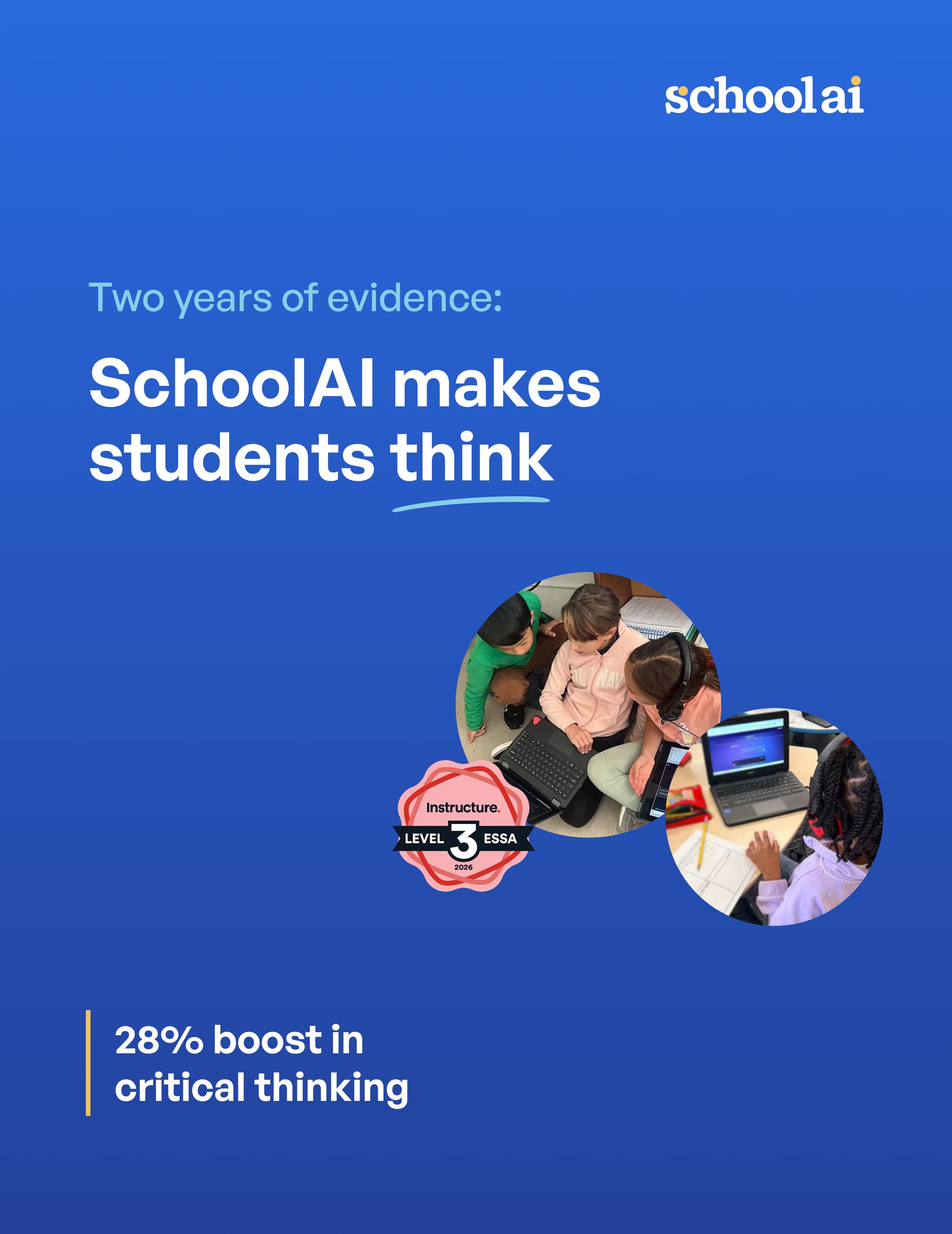
A two-year study of 13,882 student-AI conversations shows a 28% boost in critical thinking and earns ESSA Level III certification.
Can AI in the classroom deepen student thinking instead of replacing it? New research from SchoolAI followed 82 teachers in Utah's Jordan School District across two years, analyzing 13,882 student-AI conversations to find out. The answer is yes: students using SchoolAI showed 28% greater critical thinking by 2025, with gains holding across every subject and grade level studied.
The Jordan district serves 55,000 students across 68 schools. Researchers compared two snapshots, October 2023 (just two months after SchoolAI launched) and October 2025 (after two years of use), tracking the same 82 teachers at both timepoints. Each conversation was scored on a four-level rubric adapted from Bloom's Taxonomy, from basic recall up through apply, analyze, evaluate, and create.
The shift was dramatic. In 2023, more than three-quarters of student-AI conversations (76.7%) showed no observable critical thinking, mirroring the pattern documented in classrooms for decades. By 2025, that share had dropped to 58%, and nearly half of all conversations showed students reasoning, comparing, evaluating, or creating. Levels 3 and 4 more than doubled, mean scores rose from 1.38 to 1.77, and 65.9% of teachers showed measurable growth.
These gains weren't tied to who was using SchoolAI, but to how teachers were using it. Teachers who actively designed learning experiences on the platform, creating six or more unique Spaces, showed significant gains. Teachers with minimal usage did not. Even within Level 1 conversations, choice-based activities like book selection tools, historical character simulations, and branching scenarios grew from 20.1% to 36.2%, while minimal responses and off-topic chatter decreased.
In two years, students went from a classroom pattern dominated by recall to one where nearly half of all AI conversations showed higher-level thinking. That didn't happen because students had access to AI. It happened because SchoolAI gave teachers the tools to design learning experiences where AI guides the thinking instead of replacing it. That's the difference between AI in classrooms and AI that actually improves learning. This study shows what changed; SchoolAI's companion report, Design Matters: How SchoolAI Architecture Shapes Student Thinking, examines the design choices behind the gains, including how Spaces scaffold rather than answer, how the AI is tuned to ask questions back, and how teacher prompts steer student thinking.
Download the full report to see the study design, the complete inter-rater results, and what the ESSA rubric required.
A study of 1,070 students across 36 schools finds that regular users report stronger engagement, deeper thinking, and more confidence in their future
Read article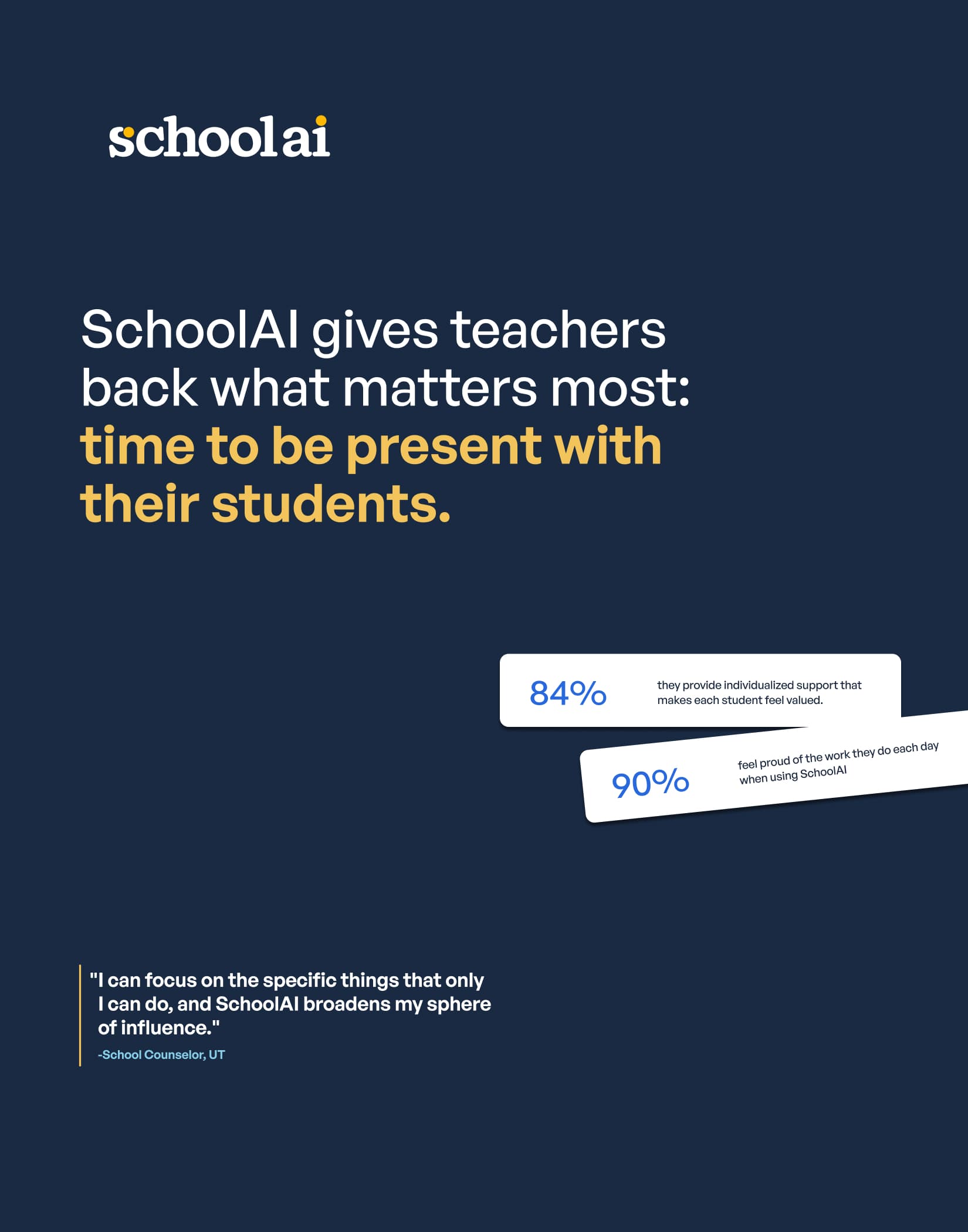
Survey of 756 K-12 teachers shows time saved goes straight back to students
Read article