School leader concerns about AI: What schools need to consider
Explore school leader concerns about AI, from privacy and bias to teacher readiness, safety, and responsible implementation.
Blasia Dunham • Oct 12, 2026
AI Literacy Safety & Policy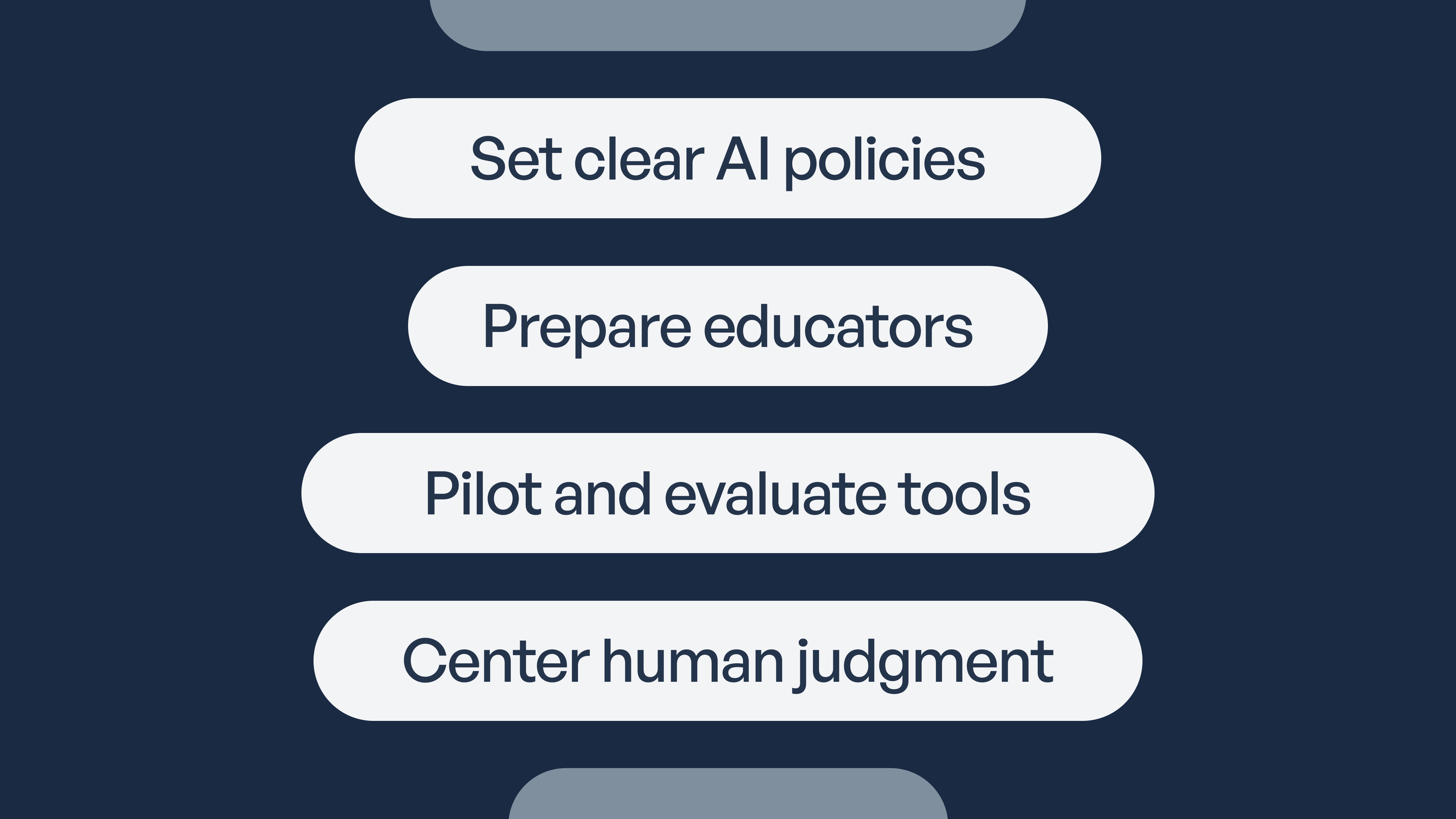
AI has become a real part of K-12 education, and school leaders are approaching it with good reason for caution. Some districts are restricting generative AI for students through eighth grade. Leaders are weighing real instructional and administrative benefits against concerns about safety, privacy, equity, and accuracy. The useful leadership question is narrower and harder: where does AI support your educational goals, and where does it need safeguards or limits? This article walks through the biggest concerns, from student data, accuracy, and bias to teacher readiness, policy, AI literacy, and protecting human judgment.
Key takeaways
-
School leader concerns about AI are legitimate, and the risks shift depending on whether a tool automates office work or talks directly with students.
-
Strong vendors can show their work: independent efficacy research, clear privacy protections, and safety controls built for kids.
-
Responsible implementation starts with a learning goal, a clear policy, trained staff, and a small pilot.
-
Judge screen time by what happens during those minutes, and choose platforms flexible enough to step away from the screen.
-
Teachers keep the final say on instruction.
What are the biggest concerns school leaders have about AI?
Students found chatbots on their own long before most districts had a policy, and families started asking about it at board meetings. The most common concerns fall into a few areas: student data privacy and security; AI accuracy, hallucinations, and over-reliance; bias, equity, and accessibility; academic integrity; teacher and staff readiness; appropriate student use at different ages; and vendor accountability.
These concerns don't carry the same weight everywhere. A tool that drafts a family newsletter carries different risks than one a seventh grader talks to during class, which is why the difference between structured vs. generic AI matters so much. The work is to weigh real benefits against real risks, the way future-focused school leaders approach every other instructional decision.
How can AI benefit schools when it is used purposefully?
Used with a clear purpose, AI supports goals schools already have. It can adjust content and pacing through personalized learning experiences, give faster, more accurate classroom feedback, and flag gaps early so students who are falling behind get help sooner. AI accessibility tools can read text aloud or translate so more students can reach the material.
Some of the strongest results show up with students schools have historically struggled to reach. A multilingual student who rarely spoke in class may raise his hand for the first time because AI gave him a way into the lesson. A student with dyslexia may get access that was never built for him before. In SAMR terms, that's redefinition. For adults, AI can cut the repetitive work behind teacher burnout and track classroom progress to surface patterns, and that time should go back to instruction and relationships. Whether the user is a teacher or one of the principals using AI tools, AI complements professional expertise and shouldn't make instructional decisions on its own.
How should school leaders address AI privacy, security, and bias?
Student data privacy sits at the center of most leadership conversations, and it should. Before approving a tool, look closely at student data privacy with AI tools: what student information it collects, how that data is stored, used, and protected, and whether the vendor is transparent about it. Ask, too, whether educators have real control over student-facing use, or whether kids are typing into an open-ended chatbot.
AI outputs can also carry inaccuracies or bias, so evaluating AI tools for accessibility and equity belongs in the same review. Equity includes access: do all students have comparable access to approved tools, and does the tool work for students with different language and learning needs? Responsible procurement means reviewing privacy practices, security safeguards, data policies, and evidence of educational value, and an AI evaluation checklist keeps that review consistent. Look for vendors with ESSA-validated research, published privacy commitments, and safety precautions designed for kids.
How can schools manage AI accuracy, over-reliance, and academic integrity?
AI can produce answers that sound convincing and are simply wrong, so human verification is part of the job for instructional materials, feedback, and anything students see. Using AI as a support tool is very different from accepting whatever it says, and knowing when to allow AI in the classroom helps draw that line.
AI also changes what student work can prove. A polished essay may no longer show what a student can do independently, so many teachers are designing AI-proof assessments. Strategies that help:
-
Build assignments around reasoning, application, discussion, and authentic experiences.
-
Set clear expectations for when AI is and isn't allowed, and teach AI academic integrity directly.
-
Teach students to evaluate AI-generated information, including how to spot deepfakes.
-
Keep foundational knowledge and traditional learning goals in place.
-
Collect process evidence, like drafts and conferences, alongside final products.
AI literacy belongs with digital citizenship and critical thinking, not only in the technology standards. SchoolAI's Student AI Literacy content in the Teaching and Learning Hub gives teachers ready-made lessons to start that work with students.
Turn AI concerns into confident classroom use
Give educators safe, teacher-designed AI experiences with guardrails and real-time mastery data that keeps learning outcomes and human judgment at the center.
What does responsible AI implementation look like for school leaders?
Responsible AI in education starts with a learning goal. Adopting a tool just because it's available rarely ends well.
1: Establish clear AI policies and guidelines
Define appropriate use for students, teachers, and administrators, and adjust by grade level, since a kindergarten room and an AP class need different rules. Address privacy, academic integrity, transparency, accessibility, and human oversight, and build in AI guardrails for students.
2: Prepare and support educators
Professional learning should cover what AI can and can't do, along with privacy, bias, and practical classroom uses. Building AI literacy among your staff works best when teachers try approved tools in low-stakes settings first, and these AI teacher training strategies can help.
3: Pilot and evaluate AI tools
Start with a defined need and a measurable goal, then follow a structured edtech pilot process. Gather teacher and student feedback and know what to measure in the first month. Expand only if the tool improves learning, saves meaningful time, or gives useful student insight (how to tell if edtech is working).
4: Keep human judgment at the center
Educators stay responsible for instructional decisions, student support, and relationships. AI should assist teachers without taking over the classroom. For a fuller roadmap, see this practical framework for managing AI implementation in schools.
How can school leaders balance AI innovation with the human side of education?
Technology can't replace mentorship, collaboration, or the trust between a student and a teacher who knows them. Used well, AI can strengthen the student-teacher bond by taking repetitive work off educators' plates. That's the human side of AI.
Screen time deserves serious attention, and the better measure is what happens during those minutes: whether the time is instructional, rigorous, and moving learning forward. A student scrolling for 45 minutes and a student using AI to finally understand a concept are doing different things. Districts should also look for platforms flexible enough to support that judgment, such as printable, paper-and-pencil options and the ability for teachers to pause a session and spread the work over time. Student voice, educator input, and family communication help set expectations that make sense, and students can even advocate for ethical AI use themselves.
How SchoolAI can help schools address AI concerns
Every AI company serving students should have to clear a high bar. SchoolAI gives students safe, classroom-ready AI inside Spaces, teacher-designed experiences with guardrails that keep conversations focused on the lesson. In Mission Control, teachers see student conversations as they happen and stay in complete control. They can step in when a student needs a person, or pause a session to break the work up over time. Teacher tools also let educators print worksheets, so students can learn with paper and pencil instead of a screen. SchoolAI is FERPA, COPPA, and SOC 2 Type 2 compliant and does not use student data to train AI models. Real-time mastery data lets educators see student needs in real time and check whether students are reaching intended outcomes. An ESSA Tier 3 study found a 28 percent increase in critical thinking, a harder outcome to move than engagement or time on task. To see how SchoolAI supports responsible AI adoption, request a demo or explore district management.

About the author
Blasia Dunham
Education Specialist at SchoolAI, Former Technology Integration Specialist
Blasia is a former technology integration specialist who spent years coaching teachers through co-teaching, hands-on training, and one-on-one support. A semi-finalist for AI Educator of the Year, she's known for turning teacher hesitation into confidence. At SchoolAI, she helps educators find their footing with AI the same way she helped teachers find their footing with tech: side by side, one step at a time.
Transform your teaching with AI-powered tools for personalized learning
See how every student is doing, and know what to do next.